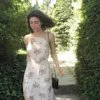
05: Megan Major on ‘The Wall’ by Marlen Haushofer
I wouldn’t say my relationship with reading is fraught, but it isn’t as consistent as I'd like it to be. The same could be said about my relationship with writing. Both nourish me; both expand my thoughts, widen my perspectives, and help me live outside of myself. So, why then, am I so determined to put them off? Why insist on dwelling in darkness, haunted by ghosts long due to be expelled? Maybe my relationships with reading and writing are fraught after all.
With today’s mounting anxieties, it’s easy to get trapped in hopelessness and helplessness. It’s tempting to disengage but the more we try to ignore our problems, the more they return in unmanageable ways. I constantly have to remind myself that immersing ourselves in the art of others, as well as in our own, is a way to nurture spirituality and imagine how life might be lived better. That practice gives me hope for the future, even when the present feels so fucking bleak.
I keep returning to Marlen Haushofer’s The Wall, a book I read earlier this year. I didn’t even give it 5 stars, yet over time, it’s proved its lasting impact on me. Written in the 1960’s, the novel follows a woman who wakes up one morning to find herself cut off from the outside world by an invisible wall. Everything on the other side of the wall appears frozen in time and she must find ways to survive in her new isolated reality. She becomes the caretaker of several animals, lives off the land, and keeps a journal without the expectation that anyone will ever read it.
Her story is a reminder that survival is not purely physical but spiritual as well. Even in isolation, meaning can be made through care, attention, and imagination. Unlike her, we can lean on community and don’t have to move forward alone.
I don’t know if art can change the world, but I use it as a tool to help improve my own
– Megan, October 2025
Megan Major is a Detroit-based artist and co-organizer of the Detroit Art Book Fair, an annual event that brings together independent publishers and artists to share their work with the public. Working primarily with photography and the artist book, her practice reflects on memory, transformation, and the quiet tensions between preservation and decay. While most of her books are photo-based, A Book of Images incorporates her own writing, extending her exploration of how the visual and the verbal can coexist as parallel forms of memory.
Through the Detroit Art Book Fair, Megan helps cultivate space for artists and small presses. She is dedicated to expanding access to independent publishing and creative exchange. Her recent contribution to Nox Library’s 30-Second Review series reflects her belief in art as a means of endurance and imagination, a way to nurture connection even in times of fragmentation.