Conversation 10: Drew Younker (Dryfruit)
My conversation with Drew from the band Dryfruit marks a point of departure for Nox Library’s re-newed exploration into music. As one of the most accessible art forms, music has historically held up as a pillar for people’s cultural movements in the face of capitalist rule over culture. In our conversation, Drew highlights the particular struggles musicians face under the conditions of US capitalism by proxy of the music industry. She also emphasizes how these particularities are brought into the fold of a larger, broader struggle waged by all artists and working class people. We discuss her art, contradictions, economics, and, most importantly, we take time to ponder: what is to be done?
-Danielle
Drew Younker is a musician, worker and activist living in Detroit, MI. Her band, Dryfruit, builds on the solo material she wrote and recorded over the late 10s, expanding on the bedroom pop pallet and drawing influences from MPB, bossa nova, dub reggae, and japanese rock/shibuya-kei. Dryfruit’s live sets are accompanied by Noah Kim on guitar, Virginia Mary on drum sequencer and synth, and Khalid Malik on bass.
Danielle is one half of Nox Library.
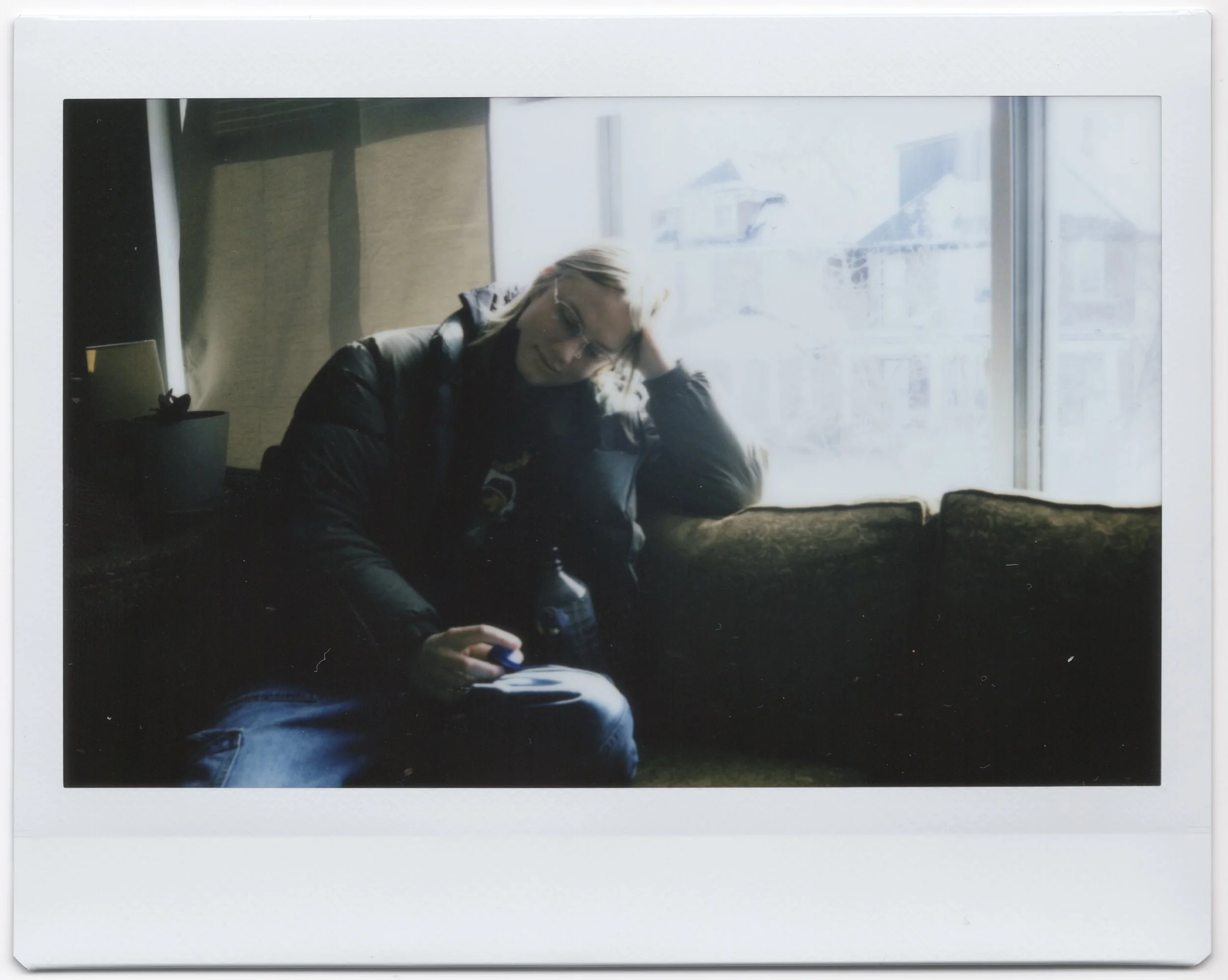
Image of Drew taken by Danielle
Danielle Francisca (DF): Alright, hi Drew.
Drew Younker (DY): Hello!
DF: So, I think I mentioned before, you are our first in a long time (and our second overall) artist who is a musician that we've had a conversation with in Nox Library. A lot of artists that we've talked with before are more in the visual realm, or they do a lot of different types of media.
You have a band called Dryfruit, which is based in Detroit. It's a dream-pop project—you want to talk more about that?
DY: I'd love to. Thank you. Well, first of all, thanks for having me. You know, I'm excited to talk about all things art—music. Visual art, I don't know, I couldn't… I can't even do, like, MS Paint and stuff.
But the Music World is very interesting when it comes to all the issues that Nox tackles…
To get into Dryfruit—It is basically a continuation of the solo music I made under the name AnDY for about 8 years. Musically, I would describe it—there's usually a drum sequencer, heavy, reverbed chorus guitars, and influences, like Stereolab, Deerhunter…
The namesake itself, Dryfruit, comes from this record from this band, Sugar Plant, from Japan, which has this very, very calm, soothing style of rock music.
Our biggest influence, I would say, is Radio Dept. I kind of wanted to bring them up because they're an expressly political band that also has crushing, heart-wrenching songs about queer love, but also songs that are anti-fascist explicitly.
DF: Can you name any songs in specific?
DY: There's a song called “Death to Fascism”.
DF: Amazing.
DY: Then the first track off of their record, Running Out of Love, is called “Sloboda Narodu.” I probably mispronounced that, but that's the mantra of, like, the Yugoslav and Albanian partisans, so it's like a communist phrase back from the 40s.
And that's the second half of the “Death to Fascism,” a mantra meaning “freedom to the people.”
So on top of just being some of the coolest songwriting, one of the only bands I can dig into forever and ever with the music itself—they blend dub and shoegaze and all these dance styles together really seamlessly, but also are explicitly anti-fascist and supporting of the only people who have ever thwarted, or defeated, fascism before, which is Communists, right? Which is communist people's movements, or movements inspired by Marxist thinkers.
So, anyway, I just like any excuse to talk about Johann Duncanson, and his singing, and I would just say that they're our biggest influence.
DF: I love hearing that. Dryfruit did just come out with the first single, “Hold Contra,” which made me think of the Stereolab song, of course, “Contronatura,” but you also posted something about what inspired you to write that song, and that was contradictions.
What was that like? What contradictions in particular?
DY: Yeah, so “Hold Contra” kind of came about when I was going through a recognition of every contradiction that up until this point in my life, I had shoved away, or decided to make black and white. Or, in essence, to be honest, a lot of the contradiction and tension I felt in my life, surrounded by my identity being transgender.
The first few lyrics of the song are “Clocking in at 8:30 sharp as it goes, such a chore. I hope that I fit the crime the way I had before.”
And I guess the feeling I'm trying to… Inexplicably trying to squeeze out of this track is, like…
These contradictions used to torment and haunt me—even with my own personal identity, and then with the world outside. This is post-COVID; this is 2023 when I'm writing this song, but this is post-me exploring this part of my life and recognizing that not only is there a contradiction, in the locus of control in my own identity, fighting for acceptance, but also the contradiction of me having to work 1 hour for myself and 7 hours for somebody else every fucking day, and how these don't mesh. At the same time, I can't take enough care of my body, feed myself, feed people around me, or have time to fuck off and make albums all the time, too.
Basically, the song just shines a light on the contradictions and how they are the productive engine of our existence, and—I guess as cliche as I'm getting—it inspired me once I accepted those contradictions. I'm trying to hold the contradictions, and that's what the song is. It kind of drags you through the mud at the end, but there's a rainbow, too, so… hopefully people can kind of hear that when they listen to it.
DF: I think there's lots to be said about contradictions. You did mention the personal contradictions, and then there's obviously the contradictions that we face—especially as working-class people—that we face every day in society that we’re forced to confront.
Then there are the contradictions you would face being a music artist. One of the decisions that you made when putting out your song was to not stream through Spotify, right? And then to not stream in Israel, either. And I appreciate that, because it has had me thinking about the ways that artists engage socially and politically, and how artists work towards change—progressive change—and making a better world possible.
In the visual arts, people refer to the “art world” a lot, but the music industry is really not that different. With Spotify, there's the Boycott Spotify campaign that's really big. Do you want to talk more about your thoughts on how music artists specifically engage with campaigns like that, and also just engage with broader world issues through their art and the engagement with the music industry?
DY: I'll do the Israel one first. That decision came from a campaign called No Music for Genocide. I saw a lot of DIY bands from Chicago and the Midwest all taking their music from distribution out of Israel—not to say, “oh, they're gonna be so hurt to not hear these DIY bands,” to be honest. It's just like…the No Music for Genocide thing is a no-brainer to me. There should be less treats for empires that are pillaging and stepping on other nations. Even though when you make something, it's no longer really yours, right? And I do kind of believe that when you make a song, or if you make a piece, it kind of just goes off into the world like any piece of labor. It’s artists’ way of one, recognizing….
DF: Two, making a statement in some way, but then three, holding their own fruits of their own labor…
DY: Right.
DF: …from, like you said, those empires that are pillaging and genociding.
DY: That's actually an interesting point that you bring up.
DF: You saw a lot of DIY bands from the Midwest and Chicago do that. Where is the solidarity between those smaller bands and bigger bands, or bigger music artists, that have large labels backing them? Is there anything to be said about smaller bands doing this, and do we see larger musicians being able to do it as well?
DY: At the risk of making a false comparison…
There is a thing—especially with DIY bands, and then the mid- to whatever you'd call large-range bands—where it's a quantitative difference that creates the qualitative difference of how they operate, and how they book a tour, and how they are funded and think about this shit.
Deerhoof is a good example of a larger band that decided to take their stuff off Spotify. What I always see is the people that are DIYing—doing it on their own—they really have nothing to lose. So, is it easier to stand on your morals before you're captured by the system that you are there to rail against?
At the same time, I don't think anybody's making enough money off this shit to care in the first place. I really think—and maybe let's talk about streaming, generally, and Spotify—the reason Spotify is a good targeted boycott campaign effort is because Spotify doesn't have… like, Apple will sell iPhones if it doesn't have Apple Music. Google owns half the internet. YouTube, same thing. Spotify is really just…music streaming? And what Spotify has done is developed a team of crackpots to decide the exact number that every person would like to pay for all music in the world every month, and then decided that's the number it was gonna be.
They haven't turned a profit yet, but on speculation, investments, and just sheer popularity, they've stayed afloat, degrading the entire… “art world,” you'd call it, but the music world of music. Everyone doesn't give a shit about songs anymore, they're worth less than a penny on the ground.
I think that streaming is a contradiction that we have to play out till it fucking breaks. To make that happen is if Spotify would have to pay out enough for it not to exist anymore. And that's the other thing, too—all these capitalists, I thought they wanted to have a fair game. Well, this is the game, man. This is not a viable company. You can't sell $10 for every song in the entire world.
I know I just went on a whole tangent, but…
No, that's a fair statement. The acceptance of AI slop from Spotify is just another example of how ready they are to degrade their own commerce. Like, for the benefit of who? I don't know, it's just capital compounding on itself, right?
DF: Hmm.
DY: But does it make an opportunity for that style of trade union consciousness? I don't know. There is the Rashida Tlaib bill…
DF: I was gonna ask about that.
DY: Yeah, called Make Streaming Pay, which is UMAW [United Musicians and Allied Workers], Living Wage for Musicians Act—A bill to regulate these services and ensure whatever fair payouts, whatever that looks like, right?
These conversations are down the road, but at the end of the day do I think streaming is the future of music? No, but at least this is some terrain that can be fought over, especially the Spotify thing. I think it's pretty inexcusable to put your art—something you crafted and care about—on this platform which is gonna get invested in AI military tech, just for them to give you [jackshit], it makes no sense.
DF: Going back to the bill Rashida Tlaib is working on, this is a bill—correct me if I'm wrong—but this is a bill to increase the amount of money that an artist can make from their music being streamed, is that right?
DY: Yes, that's correct. It's different per platform, but Spotify, for example, is 0.007 cents per stream. I don't even know how many you'd need to get to a penny…
DF: So when we think about what artists can do when it comes to these sort of things, obviously there's the campaign to boycott Israel, campaign to boycott Spotify, but it also sounds like there can be actual policy change that artists can get behind that'll benefit them, but that will also be some sort of resistance to the capitalist idea to put profit over people.
What more can musicians and artists in general do, do you think?
DY: I think especially in somewhere like Detroit, where there is a lot of money to throw around on art, by maybe nefarious actors—
DF: Billionaires.
DY: —that really, especially with music…and this is gonna go beyond my little dream-pop thing…
DJs, and people that do Dance [music] and control the night, cannot take this money from these billionaires, and need to carve out a corner of the block and say, “this is all us.” And it doesn't have to be any one thing, but I'm just saying there has to be some kind of rejection of the slushy money that goes around.
You know who I'm talking about, too, right? There's a lot of Zionist money in Detroit, there are a lot of developers, there are a lot of old heads—Gilbert, etc. Besides that, I think if you are a musician, or if you're an artist at all, you have to pay some of this back [to the community].
The next Bach is probably in the Congo mining cobalt, so what are you doing? Joining an organization, or spreading a ballot initiative at a show? I think that those things are just the bare minimum that artists need to do on top of whatever they'd like to do personally to express whatever they see in the world. Those are a few examples.
DF: I think those are good examples, and they have me thinking, too, that artists’ engagement with politics, or even with resistance and struggle, does not require that their art reflects that, or does not require that their art be a political message in and of itself. I do think that people feel intimidated by that sort of engagement, because one might not want to compromise their personal expression that doesn't want to explicitly make a political statement or something like that.
That's kind of what we talked about earlier when we talked about the music industry, or even the art world. To step outside of that and engage as a person in the world is one way that artists and non-artists alike, or even cultural workers, can engage and enact change that will also benefit people who create art, and who are working class, and so forth.
These ballot initiatives that you mentioned—your last show that you had, you had petitions for Invest in MI Kids and Move Money Out of Politics, which is an easy, what—how many signatures do you think? 50?
DY: 50, and we didn't even have to stand in the cold.
DF: Didn't even have to stand up and go canvassing for those, and that's amazing. Stepping outside of your brand as an artist, and just being a community member and joining an organization is extremely effective, because whether or not you're an artist, you should be doing that.
DY: It's gonna be necessary, too.
DF: We are way past the point of realizing fascism's on the way. People are getting killed, our country is bombing other countries, and we have to look out for our own community and our own city as much as possible, because at the end of the day, the only people that can hold our U.S. government accountable, and that can hold our city government accountable, is us. It's our responsibility more than it is anyone else's.
Now I'm going on a tangent. The music industry doesn't exist to benefit artists, it exists to exploit artists, you know? So you need to step out of that in order to resist it, and to resist capitalism, and thus, imperialism, and so forth.
DY: I'm doing this all to have more time to do art, not because I think my art is gonna save the world or something. Does that make sense? I think we all need more time in our lives that isn’t spent working, healing, toiling, struggling…
Whatever people do at that will be the fruit of all this hard work, but you still have to do that part.
DF: That's the other thing about the music industry, art world—whatever you want to call it, or whatever you want to refer to—is that it does really promote this idea of individualism, because that's how you kind of keep people siloed in a way that makes it really hard for people to collectivize, and to think about what benefits us collectively, as opposed to what benefits us individually, and how to prioritize the collective over the individual…
DY: It's the brand.
DF: I know we're a little over time, but that's fine—let me backtrack. Your music itself isn't explicitly political; you don't always carry political messages in your music, but do you ever feel that need to, or do you think that your balance is achieved in a way?
DY: There are songs I've written before that were political, because it just made sense to. A lot of the songs I write end up sounding angrier when I write lyrics down than I thought…
I name-checked Joe Biden one time, and when I play that song live, I'll sneak another name in there, like Mike Duggan or something, but to be honest, I really like to just talk about dialectics behind life, and in the music, and exploring that has been fruitful for me. Exploring those contradictions has proven to be fruitful in my own political discovery and radicalization, too.
DF: You mentioned that there were some artists that inspired you. Was that Radio Dept.?
DY: Oh yeah, there's Radio Dept. that I mentioned earlier. But there's so many. I'm also very inspired by the Copenhagen scene, how kind of weird—Erika de Casier and Astrid Sonne—how kind of out of left field they are, although they come from this kind of hoity-toity school in Denmark, that they then all dropped out of, and then made better music after.
But it's really, for me, it's a lot of Stereolab, Radio Dept., Fishmans, Sade, Astrud Gilberto. I'll send my list, and you can make it drop like a Star Wars credit roll.
DF: I know that these conversations could go on forever, because these are some pretty intense topics that we cover, but I appreciate the time you took to talk with me and to share some things. So I guess if people did want to listen to your music, I'll link it, but where do you have a… you have a band camp?
DY: Yeah, dryfruit.bandcamp.com.
You can follow us on all those websites. It's basically just dryfruit.music, that's our Gmail, too. We'll be playing shows in Detroit. We have a show in Cleveland at the end of the month, we have a show with Cootie Catcher in March.
And… Yeah, thanks for having me, and thanks for letting me blab post wisdom teeth removal.
DF: Amazing, you did great, and thanks for letting me blab.
DY: Of course, it was a treat.
End.