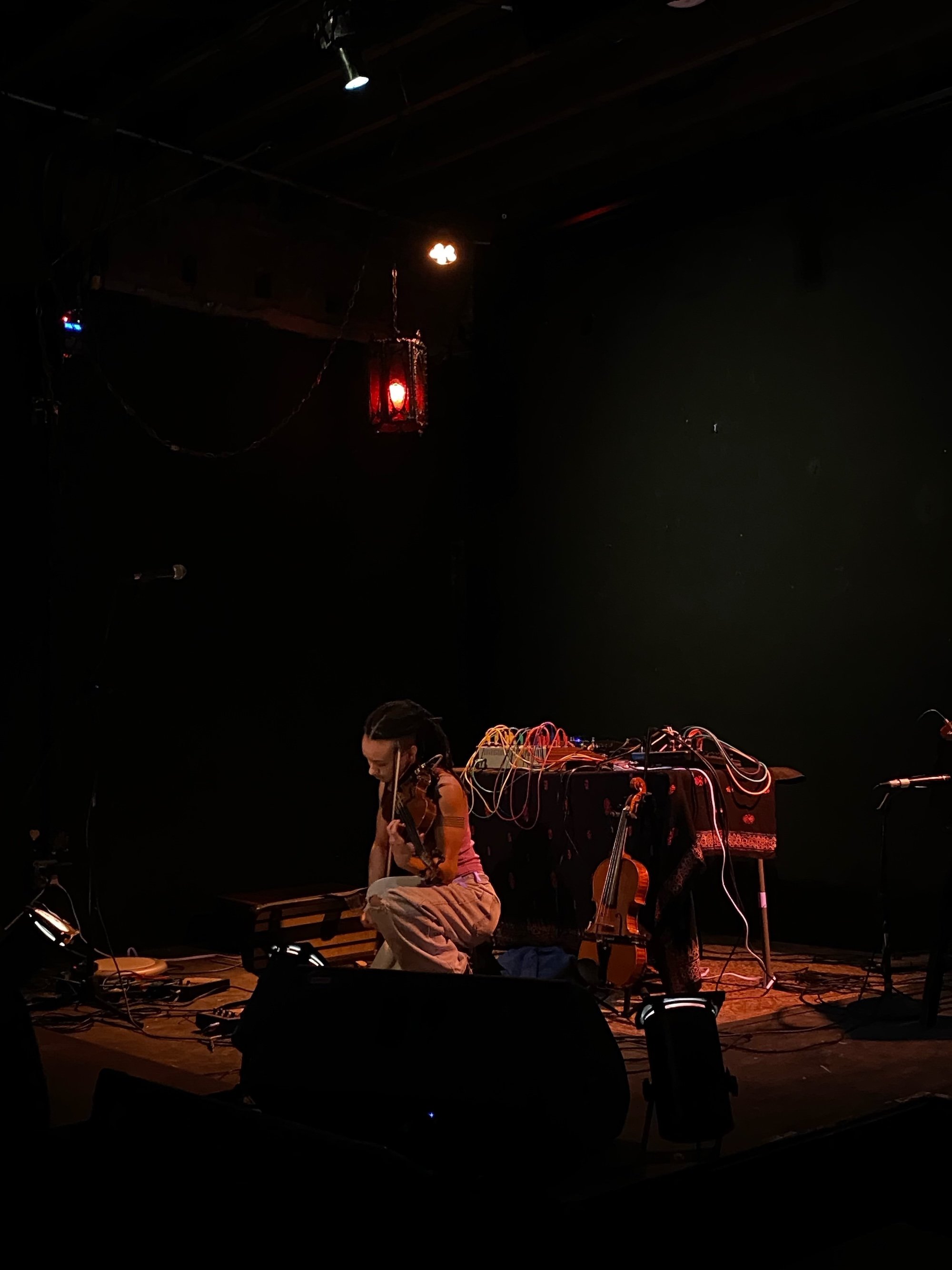
Conversation 11: Indira Edwards
One of my early memories of my friendship with Indira involves hearing stories from when they would repair instruments they rescued from abandoned schools in Detroit. Since then, we’ve always shared thoughts revolving around art, community, and how to make the world a better place. What you’ll pick up from my conversation with them is they are steadfast in what they set their mind to, and out of it comes a beautiful conglomeration of art that presents itself in various forms across numerous spaces. From a project that involves wind-up toys and an ensemble of non-musicians, to performing benefit shows for the People’s Assembly and playing viola in local bands, Indira’s music knows no bounds, and it sounds like that’s the goal. While we talk about collectivity in music, our conversation is furthermore a showcase of how Indira singlehandedly makes their art form accessible. By the end, I felt my own spirits rise—it’s artists like Indira who give me a lot of hope for the future. The artists are alright!
-Danielle
Indira Edwards (they/them) is a violist, composer, and music educator currently located in Detroit. They are completing their Bachelor’s of Music at Wayne State University and feature in a variety of projects in Detroit, including Dick Texas, Pirouettes, The Hum, Mike Khoury’s Spite of Darkness, Field Kitchen, The Yvonne Pruneau Quartet, White Flowers, and Urban Arts Orchestra. Their project, Iron Joy, with John Pablo Rojas, is an experimental duo of varying instrumentation, seeking to share stories inspired by both Rojas and Edwards’ lives. (Bio continued at end)

Photo by Doug Coombe, courtesy of Indira
Conversation with INDIRA EDWARDS, MARCH 2026 (Transcript)
Danielle Francisca: I appreciate you meeting with me. I wanted to talk with you because I think you’re a brilliant artist, that's the first reason, but the second reason is part of what makes you so brilliant is the fact that you juggle so much, and you do it within different spaces. I feel like you really operate within different realms: you're classically trained, you're pursuing academics in music, you do a lot of experimental music, you're in bands, and you also exist within the music scene of Detroit that is a little more “underground,” or however you want to call it. So, I wanted to hear more about that juxtaposition.
Indira Edwards: I am a classically trained violist. I am pursuing my Bachelor of Arts in Music right now at Wayne State. Originally I was on a different track, but this allows me to get through my degree in about 2 years less time, so it feels really good to be almost there.
The idea of juggling all these different ideas, or these different sub-disciplines within the overall discipline of music—I think a lot of it comes down or comes back to sort of the working philosophy that I have, which is this philosophy, or I guess sort of psychological framework, of self-determination. It's a framework for understanding the psychological needs that lead to a person's motivation and personality, and it's centered around the belief that people innately want to get better at things. For me, that thing is music, as well as community, and using music to strengthen the communal bonds and the communal happenings that are happening in my home community of the people that I live with and interact with on a daily basis, but also the greater community as a whole, and creating spaces for these different subcultures to interact in ways that I don't currently see happening. I'm sort of world-building with this, because I want to, because it feels good to, because I'm motivated to get better at all these different things.
Within self-determination, it gives sort of an outline. There are these three main psychological needs that you can consider—that's the need for autonomy, which is having independence and having freedom to do these certain things that you want to do; belongingness, so this desire to relate to others and have shared experiences with other people; and competence, and that is being good at the thing that you're doing. For me, that is not necessarily playing the viola, but it does include playing the viola, teaching and becoming a better teacher and educator, becoming a better community member, and having the agency and the honed ability and skill of bringing people together to do certain things.
Right now, there are so many projects that are going on, allowing me to do this thing. And yes, it's overwhelming at times, but because I enjoy doing it, I keep making myself do it. Even if I don't enjoy it in the moment, I know that it is a worthwhile pursuit.
From self-determination, the bridge between all those three factors is really the sharing of these lived experiences. I know that you and I talked really briefly about the goals of Marxist-Leninism, and that practically within the praxis of leftism, it is bringing together people of varied perspectives who can sort of agree that we have a common goal. Music, in that case, is sort of a moderator of a conversation between lived experiences. There's a project that I'm currently engaged in with a former roommate of mine, and we literally have kind of determined that the genre of our music is self-determination roommate music.
DF: Is this Iron Joy?
IE: Yes, this is Iron Joy.
DF: I saw that, and I saw that it was called “creative storytelling,” so when you were just explaining this, it made me think of that.
IE: Yes, yes, that means we're doing our goal well.
We sort of share the same brain cell as former roommates and as best friends, so we really use that space as, like, ‘yes, we are getting better at making music together,’ but our main goal is really just to communicate, like hanging out. It just takes a sonic form, and it also is fun… like, taking fun to be a motivator that leads to our liberation. Our liberation being the delaying of gray hairs and, you know, stress. It's stress-relieving.
It also is a lot of resource recovery for us. It's using what we already have and what we do well, and exploring the simplicity of that. It engages our deep listening practices of finding sounds within anything and finding music within any sound that just sounds really good. That's what John Pablo and I really do best—when we lived together, we would just hear sounds and be like, ‘oh’. It was just really silly.
DF: So for that project, for example, you were saying it's a way to be together, but when you share it with the rest of your community, what kind of contributions do you see your music making? And do you see that idea of self-determination coming up in other areas of the music community, or are there challenges with that?
IE: I think there are definitely challenges. A challenge in communicating self-determination roommate music, the way that John Pablo and I do it, is it's very experimental. It contrasts a lot with the other genres that are happening in the city, so there are sort of limited spaces for us to be doing this. Specifically, the crowd of people who go to Moondog, the experimental improvisational crew, or, you know, sort of general community in Detroit and Greater Detroit.
There are ways that music-making bleeds into other things. I think you'll see it on Saturday at the show at High Dive. I'm gonna sort of put a more experimental taste on the songs that I've been working on, because it is the type of music that I want to be making. I think the more that you share that experience, the more that you allow people to look in on that, like look through the crack in the door and just witness people hanging out and having fun. It sparks this voyeuristic joy of ‘oh, I want to be experiencing this sort of feeling, I want to be an active participant in things like this’. Whether that active participation is just listening or going home and making music with your roommate, or exploring, reflecting on those relationships that you have that bring you joy.
DF: You referred to hanging out and having fun. I think music is such an accessible—actually, and I'm open to hearing people debate this, but I think music is the most accessible art form. We encounter it every day, and it can really be made in any sort of way. Music is always there through all emotions, and these happier, more fun moments especially. I'm curious to hear, during a time like right now, when there's so much going on and especially by our own government [i.e war with Iran, the attack on trans rights, ICE terrorism across the country, etc.], what is the importance? Why is cultivating this sort of culture within music important for reconciling with everything that's going on right now?
IE: I think that's a great question. I think music in general is such an important cultural asset, like food and language. You're sharing these shared experiences, you're sharing slightly different, nuanced perspectives all the time, because you have musicians of different backgrounds in different groups and on different stages at any given point. No matter how similar music may be at a specific show, everybody is bringing a varied perspective into that. I think music making—as all sort of art therapy forms—is the most accessible because you can apply the sort of techniques that a musician would apply, and it does not matter your ability or your familiarity. If you have ears, or if you have some sort of senses, you can experience music in any way. If you're blind, you can hear music. If you can't hear, you can see music and you can feel it. Beethoven was deaf, but he could feel… you can feel the music.
You can also communicate—like, language is not music, and I don't think that music is language, necessarily. I think those are completely different cultural assets, but they both serve a very similar purpose of communicating. I think the more communication we have, the better, because communication is what keeps people not isolated.
DF: Music brings people together. Isolation is just so unnatural to human beings. It leads to a toxicity that fosters a lot of reactionary idealism that works against collective groups of people, as opposed to working for collectivity.
I think that’s what music symbolizes, is this manifestation of collectivity, of harmonies, or even instruments working together, or people working together; or, if it's by one person, one artist, it’s still something being composed, and these elements are working together to create music, whether it's in pattern, or in a certain melody, or however.
You have the show coming up on Saturday, and it’s also a benefit show for the People's Assembly, is that right?
IE: Yes, it is. I'm really excited to be on the bill. Drew Holm asked me to play the show a while ago, and I was like, absolutely yes. I, at that point, and even a little bit now, feel like I don't necessarily have a complete set, but I'm just happy to be there and be bringing people in who know me and might not know the other acts on the bill, and I think that's the most important part, is really just gathering people for a cause. Using music as a reason, as a motivator to get people out and to go experience things. It doesn't even matter how you get the funding together, you just gotta get the funding somehow, and art is such a good way to do that.
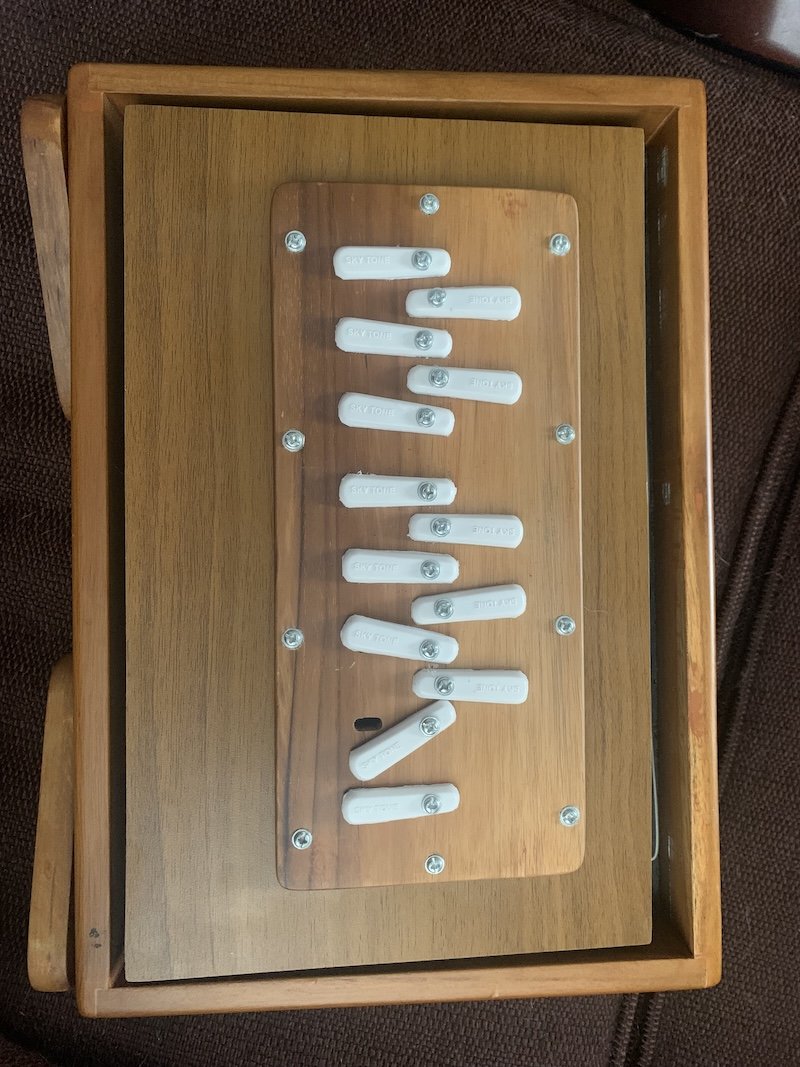
I think music is inherently, and very much so, a social activity. Even within music made on your own—like bedroom producers and stuff, that was a big thing of the mid-2010s, and I think it was really pushed to younger crowds to kind of push them into this isolated, reactionary, idealist space. I think that's totally a contributor to it, but I think at its best, it can allow for growth of one's capacity when it's done correctly and still engaging a community. The writing process for my set for this weekend has been one where I'm turning inward and doing a lot of reflecting with my songwriting, and also considering the different combinations of instruments that I could use for the show and experiment with doing something with sort of background instruments as the main instrument, so there's no guitar, there's no drums, there's no bassist for this band, it's really just viola, and then some drone instruments that my bandmates will be playing, and possibly another string player, too, so I'm excited to sort of communicate, in this non-traditional way, musical ideas.
DF: I'm gonna be honest, I don't know what a drone instrument is.
IE: I have a Shruti box, and it's sort of all… like, do you know what a melodica is, or a harmonium? It's sort of like an organ that is created with air, so it has these free reeds within it, and it's hard to change the tone while you're playing it, but—here, let me grab it. It's just on my table. It looks like this.
DF: Oh, lovely.
IE: Open up the back, and it… it has these bellows. It's really cool.
DF: Where does that originate from?
IE: You can see a lot of instruments like these sort of intended drone instruments, you can see them a lot in Indian folk music or even really, really old church music to sort of hold a tone so that people can sing over that. It’s mostly a tuning note, but you can explore it in other contexts.
DF: That goes directly back to the point we mentioned earlier, how music can be made, and any sort of mechanism can be an instrument.
Again, I appreciate you giving me more insight. What you mentioned about self-determination, it makes a lot of sense to me, after hearing that, that you're able to operate in a variety of spaces. I know you also work as part of another society…
IE: I work with the Sphinx Organization. I'm a teaching artist with them, so I teach violin to younger kids on the west side of the city.
DF: Do you ever get inspiration from being a teacher and finding a sense of community as an educator?
IE: Absolutely. One of my bigger projects that I'm working on right now for my sort of BA capstone is, I'm revising my wind-up toy ensemble piece from last year, and that is fully based in communal music making, specifically. When I was preparing the piece last year, I was really interested in having all non-musicians perform in it, and seeing if I had any hobbyist guitar players, or people who'd wanted to sing in a choir. This year, with the presentation of it, I'm gearing up for rehearsals now, and I'm really interested in having my ensemble members generate the musical material for it, so the score is entirely prompt-based—well, there's some instrumental parts that are written out, but for the most part, it's prompt-based, so throughout our rehearsals we'll really just be workshopping the musical material, giving the parameters of the prompts.
A lot of my teaching strategies will be really employed with that. I think something that I had to learn a lot of when I first started teaching is trying to get people to do what you want, but generally, instead of having too specific of a goal. I think that general action works way better, and also trusting people to trust themselves to make mistakes, and to move on from those mistakes. That's a big thing. Especially working with kids, they wear their heart on their sleeve. If they mess up, they freeze up and they choke, and you really just have to massage that out of them and be like, ‘it's okay, you can mess up and that's fine, I'm not gonna be mad at you, you're just playing the violin. It is fine to mess up.’
DF: And allowing them to explore their abilities and grow through making mistakes…
IE: Gives so much freedom, and also reminds me to give myself that same freedom. I make mistakes all the time—this whole month for me is a huge overbooking mistake, but I'm also like, ‘it's okay, I messed up, I'm gonna do what I can, and it's gonna be fine because it's just music.’
DF: That reiterates the importance of music being something social, because you do get that sort of culture, or care, put into oneself as an artist, and being aware that to get better, you are gonna learn these lessons, but you're also gonna have to give yourself grace and navigate the terrain. I think you can only really experience that when you're not in isolation. You can only really learn those things and learn how to navigate when you are not only doing it socially, but even more beneficial if you're doing it as part of a community.
IE: Yeah, absolutely, I think that's a really important point in music-making. Going back to the beginnings of learned social activity, we learn by watching the people around us make mistakes, and we also learn by making those mistakes and seeing other people's reactions to them. Everything has to be social, that's how we learn to be human, and that's how we learn to have empathy for other people. Knowing that this music community is so supportive makes me feel like I can explore and experiment with things, because I've learned through my peers and through my colleagues that I have that safety to do what I want to do.
DF: You receive support, but you're also giving it. I know that every time you are doing something experimental, you're inspiring someone, or you're telling people, ‘it's okay to do something that's totally non-traditional, or out of the box, and that we're here to create that together and to progress culture.’ It is a beautiful example of what it means to practice collectivity or to be in a collective in society.
IE: Totally.
End.