Conversation 12: Wes Taylor
Today is May Day, otherwise known as International Workers’ Day, a worldwide commemoration of the working class, laborers, and labor movements around the world. As a fellow worker, union member, and artist, I don’t think there is a more fitting conversation to have on the interconnections between art and labor than this one with Wes Taylor.
I have known about Wes and his work for many years and now I’m lucky enough to work with him at WSU. I recently described him as a visionary, but unlike those visionaries that keep their head in the clouds, Wes has and continues to have his work grounded in community. Wes co-owns Talking Dolls, an art and community space in Detroit. In our conversation, he shares how it started, how it continues to develop, and some of the partnerships with Talking Dolls and artists or other organizations. In the second half of our conversation, Wes talks about the development of the newly formed Union Hall Arts Residency, a four-week program that enables rank-and-file union members to participate in an artist residency with pay. On this May Day, we look to artists and organizers like Wes who uphold the continuing legacy of workers and unions in Detroit and the role of the arts in that history.
-Heather
Wes Taylor is a printmaker, designer, musician, place-maker, space-keeper, educator, and curator. Taylor roots his practice in performance and social justice. His work is multi-disciplinary as well as anti-disciplinary, combining, oscillating between, and blurring disciplines. His individual practice is inextricably linked to the constellation of collectives and networks he has formed over twenty years. Those collectives include: Complex Movements, Talking Dolls Detroit, Emergence Media, Design Justice Network, Athletic Mic League, and All Faux Everythings. His work is inspired by elder knowledge, complex science, '90s underground Hip Hop, funk, '80s disco, punk aesthetics, and science fiction. He is a recent fellow of the OPI (Of Public Interest) Lab at the Kungl. Konsthögskolan in Stockholm, Sweden and an Associate Professor at Wayne State University.
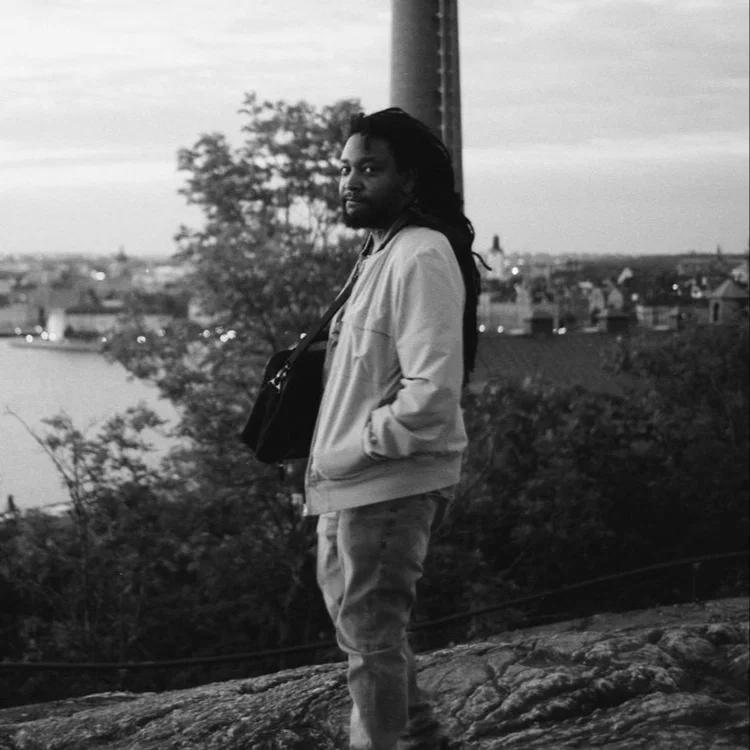
Image of Wes by Narshid Nasrabadi
Conversation with Wes Taylor, April 2026 (Transcript)
Heather Mawson (HM): Hi, Wes, so I wanted to start out by asking you a very big question, which is, what is Talking Dolls, and how did it get started?
Wes Taylor (WT): I would say I think of Talking Dolls as an art studio, but people describe it as a community space. People think of it as an event space, people think of it as a gallery, and it's really how people come into the space. Some people think of it as the print shop—One Custom City—so there's many different entry points, but it started off as a straight-up art studio with my Cranbrook friends. I just gathered a bunch of people when I graduated Cranbrook to be like, does anybody want to share space and continue what we're doing, and who wants to stay around Detroit?
So some of the people were from Detroit already that I talked to, and then some people were not and then were thinking about staying based in the city. So there was a critical mass of people. I think it was… it was 5 of us—it was me, Aaron Jones, Brian Dubois, Tiff Massey, and Andrea Cardinal. Everybody but Aaron was from the Detroit area, or from Michigan. And that's kind of how we started. It was super cheap rent, a lot of space, it was a time and place in the city where, you know, that was happening. There were a few other people at that time when we graduated that also found space, but it… Detroit at that time was not that appealing to Cranbrook grads to stick around, so… could have been a lot of people establishing space around that time, and I think it didn't catch up until later, and then prices started to increase.
HM: What year was this?
WT: 2011.
HM: Wow, and so it has stayed active ever since then.
WT: Yeah.
HM: And it’s morphed over time, it sounds like.
WT: It's morphed over time, you know, people have come and gone, and things like that. We've moved spaces. We were originally on Van Dyke—a big toy warehouse, which had a lot of interesting stuff going on. There was a lot of under-radar stuff going on, and we probably couldn't even have that space today. It would probably be closed based on code violations, but…yeah, there was a CCS group of undergrads that started a space called Chocolate Cake, and a lot of the Chocolate Cake people formed spaces. The Fortress comes out of there, a couple other spaces and practices. Then there was fowling that was in that space. I don't know if you've ever done fowling.
HM: No, what is that?
WT: It’s football and bowling at the same time.
HM: I've never even heard of it.
WT: Hamtramk, they have a huge space. It's a huge thing for, like, corporate groups to do stuff, and then there were weed grows in there, all at the same time. This is before growing was legalized, actually. That was an interesting space, and then we got forced out of there and moved. We've been in the current space for almost, like, 11 years, I think.
HM: So we just heard about what the space was, so what is it like now? What are some things that Talking Dolls focuses on? I feel like there's so much always going on there.
WT: There's a lot going on. We focus on this idea of incubation of practices and so we end up being a first ever studio to a lot of people, but at the same time, that's been our goal. So, even after the first year, we started our residency program called Incubator Residency and that went for 15 years straight. Since doing that, we've absorbed different practices and art groups over the years. For instance, we hosted Bulk Space for several years as they started to establish themselves in the city. So, you know, that practice isn’t very codified. It's just a mission. Then we try to do it the best that we can, when we can, and then, you know, try to build trust, relationship, and support. And then we're also trying to do our own studio practice.
It's a lot like coaching… like with Ricky Blanding, who is a ceramicist and has his studio in there. You know, just like a tenant-landlord situation, but then also, we're just trying to support people. We don't really have money or resources, we never have had money.
Our biggest method is—which has been the most unsexy thing in forever and it doesn't translate well on grants—but the idea of stability was a really important thing for us. Nobody really wants to hear about stability being a really important part to even an experimental practice, but it's just like, yeah, we're working on just being around here and sticking around and thinking about what those strategies are. One of those strategies: we sacrificed from being in foot-traffic-central location to be like, well, now we own the space so it'll be really hard to displace us, right?
HM: Yeah.
WT: That's a thing, and so we really focused on that. Before that, it was like, well yeah, it's cheap rent, but we can do really good stuff in that way.
We also have a legacy that we speak to—from organizing and movement building with Grace and Jimmy Boggs, and we're direct descendants and products of Detroit Summer—from being kids in it, to being directly mentored by Grace and Jimmy, to running programs and things like that. So, you know, we try to think about how those things overlap and how that legacy still has a place in Detroit, without even trying to overstate it at times.
HM: Yeah, I see that a lot, especially like you mentioned in building trust and building community, but that is a central thing, and it's not really a part of any mission statement, it's just what you all do. I feel like that falls directly in line with Grace and Jimmy and what they were focused on and what they were teaching. It's just, you have to be there. Like, you have to be in it, and you have to build those relationships in order for there to be any sort of change.
That relates to your point about stability. There's not just financial stability, there's community stability that has to be fostered. I'm a transplant here, I moved here in 2016 and ever since I moved here I've known about Talking Dolls, and it feels like y'all have just established yourself as such a stable community space that people can go to, reach out to, and it just feels accessible. I think that's honestly hard to find. Do you have thoughts around that?
WT: Yeah, I mean, I could talk about it from so many different ways. I was having a conversation with Megan Douglas from Riverwise. Me and Megan go way back, because we went to the same high school. Not at the same time, I'm a little bit older, but our friend groups overlap each other, and I've known Megan for forever. But we were just talking Talking Dolls and she hit it on the money.
Me and Ron (Watters), who we also run the space with—who I didn't mention as a founder because he came in a year after, so I just want to call his name into it—but…she (Megan) was like, “Talking Dolls is kind of like the space I would have wanted as a kid, or developing as an artist, or coming of age.”
HM: Exactly.
WT: I'm like, actually, exactly. That is what I'm constantly trying to figure out. How Talking Dolls can be the reflection of a space I would have loved to have had access to in my development of my artistic viewpoint and maturity. Because… yeah, accessibility and art space entry points. And not even just being able to go into it, but, like, demystifying it. Like… do you belong here or not? We're probably not for everybody, but then at the same time, we're not not trying to be for everybody. We're not trying to people-please the world. We're not trying to be exclusive in any way. Part of the target is our younger selves, and the roadblocks and barriers we had to spaces, and trying to open those things up.
HM: That makes total sense. With that in mind, you talked about how the space has developed over time, about creating stability, you talked about how you own your space, and that there's stability within that, and I'm curious, what are some long-term goals or projects that you have with Talking Dolls?
WT: We have an immediate project that is going to turn into a longer-term project, and it's a new venture, which is our co-op that we're trying to do. It's a printmaking fabrication co-op, and I think it's just a good time to do it, because it tests our methods that we've created. Even though, like I've said, we haven't really codified them in any way, but they're there. It’s our way to test it: can we turn this into a “business,” right?
We thought long and hard if there was a way to systematize, if that made any sense, to name what and how we do it, how to package that up in an official way, in a way that can be read and that's legible. We thought about a lot of different ways that we could organize this thing or package it for the world.
We're going with the co-op model in order to think about different scales of co-ownership, co-running, co-design of a space and the co-imagining of a space. So, once again, this idea of incubation. Incubate this co-op in the space, but not have it totally rooted in there. To have a space grow itself and then move to where it needs to go after that.
Younger artists that don't have pathways to ownership of a building can think about this collectively, and they can think about this and prepare for this collectively over a course of years, but then also kind of feel ownership over and agency over the space. Also share resources, share profits, share mission and vision building and things like that.
HM: I love that, because it really centers collectivism over individualism and reinforces how much power we have if we work collectively as artists. There's such a long-standing tradition of artists working individually and trying to do things on their own and I think it just really stifles creativity, it stifles what is possible, and it feels really important and exciting to hear that you all are working towards that.
WT: Yeah, that's an exciting thing.
I just wanted to call out that we are collaborating with Bulk Space. We just came together to be like, let's try this with a curator, in a curatorial fellowship program.
HM: Yeah, yeah, I encourage some students to apply to that.
WT: Cool, yeah, we're about to review the applications right now. I will say that I was going through a little bit of a crisis earlier today, because we have too many good applications, and I'm like, oh, wow. There's a lot of smart and sophisticated thought around curation in Detroit, and thinkers around curating in Detroit.
HM: Totally.
WT: Once again, it was co-imagined with Jess Alley from Bulk Space who was really thinking about the gaps in the development of a curator and a cultural producer. Thinking about that (gaps) and trying to provide support again through that program. I think there's been a lot of really good responses to it.
HM: Yeah, I mean, it's another point of accessibility, right?
WT: Yeah.
HM: How to make these things more accessible to folks who are starting out. Speaking of new projects, your work with Talking Dolls led to meeting Annemarie Strassel (Director of Communications at UNITE HERE) so I was wondering if you can share how that happened and what that is leading to.
WT: There are two different entry points—or introductions—to Annemarie that kind of led to this space. The first introduction was my work with Design Justice Network. I was introduced to Annemarie through one of my colleagues from the steering committee, Boaz Sender, and his partner, Sienna. Sienna's been working on larger movement-building, populist, leftist-leaning support on a national basis and trying to create these networks. She's been on a very bird's-eye view of things. Boaz and Sienna met Annemarie, introduced her, and then invited Annemarie to come to the show I had at MoCAD, Code Switch. After the Code Switch opening, Annemarie came over to the festival that we throw at Talking Dogs called the Potluck. We talked briefly at MoCAD and then we talked even more deeply at Talking Dolls. And then we just kind of visioned the thing. Anne-Marie was like, I have this vision for a place, I don't necessarily know how I want to do it. She was given space at UNITE HERE to vision this thing.
From her viewpoint, in her 25 years in labor organizing—being part of the union, and then the administrative side, to working in international communications, and being from southeast Michigan—she had seen a dwindling of the arts. But also this increase of what you would call “professionalization of movement building.” So, she felt the need to disrupt that trend in what she's been seeing in the political landscape and everything.
She noticed within the rank-and-file membership all of this creative talent, and was trying to tap into it to leverage it for campaigns, but also saw individual people that were creative, and that just needed support. She was like how do I figure this out? I need a space, I want this to be a space. She came to Talking Dolls, and was like, I like what you guys do here, what can we do? And I was like, I would be very interested in partnering with you to help see this happen, and to lend what I know from Talking Dolls into the formation of this space that you're dreaming. Since then, we've been working together to think about Union Hall Arts. Ultimately, we think our goal is to create a brick-and-mortar space in the city of Detroit that supports creative activities from disciplines to having a workshop, a studio, but also thinking about media in different ways, in terms of broadcasting information and ideas, all the way to thinking about a think tank, and what that looks like. To figure out how arts can help share this story more about labor and also help fill the lives of this membership and make them feel more fully human.
Even though I'm part of Wayne's union (WAU), I'm not culturally or grew up in a labor family or a union family. So, part of it is that I'm immersing myself from it from that end. It's important that I have this other perspective to organize, that we're merging our ideas of organizing and movement building in this space. I think the diversity of our experience is actually pretty strong, because we're learning each other's methods—there's strength there to not have this singular viewpoint on how to do this. I think it’s really interesting and it's very stimulating for me as well.
HM: Thinking about your point about not coming from a labor family—only less than 10% of the population in the United States is unionized, so the vast majority of people don't have this connection and it hasn't been a part of their lives in so long. We're at a real decline in unionization in the United States. So to hear about the Union Hall Arts project was really exciting. It’s exciting to think about how arts and creativity can bring those conversations to the forefront again and share those stories in Detroit. It can strengthen that connection and show the importance of unionization.
WT: Yeah, all of that—the way that we're thinking about how we can function beyond facilities and having space. I think part of the vision is to break down silos between labor organizations. This is gonna be a hub, even though this is being seeded by UNITE HERE, the idea of collaboration and cooperation between unions and a way to enroll in this third space.
The arts can allow for unions to not be so caught up in their very specific purpose, but create new ways and new opportunities for collaboration and to practice those things, and then to associate with each other when it's not around a campaign, or a thing. People can be open, so it's a space for people to share a strategy, ideas, wants, to just share a vision. I also think that there are all these untapped skills, and talents that can overlap in so many different ways. You have skill trades that have a lot to offer, that may be even trade secrets or very particular things that might just work in an industry, but then you have artists that can think about if we used it this or that way, outside of just commerce or working for an industry.
I think there are ways to tap all these potentials and overlaps. I'm really excited about the strategy exchange, the breaking down of silos, and in the way to acknowledge Detroit's importance to the labor history of this country—
HM: For sure.
WT: —where it's not fully realized in this city. To find a way for Detroiters to be proud of that history. There are so many labor, art, and creative stories. I don't think we need to centralize them in any way, but I think there's a way that we can uplift a lot of this history. There's a past reality of the arts and labor that was really strong. I think there's a new way that it could exist moving forward.
HM: This is a good point to talk about the pilot program that you're gonna have at Talking Dolls this summer with the Union Hall Arts Residency.
WT: The Union Hall Arts Residency is part of this concept that Annemarie and I have made up. This is the year of experiments so we're just piloting and doing things at a scale that we have the ability to try to test out. If we made this space, what could it do, what could it be? And then the fact that I have Talking Dolls as a resource to test these things out in a way that lowers the barrier of entry, because not only does Talking Dolls have a space, but it is also a place that holds a lot of knowledge and information around running residencies, hosting artists, thinking about curriculum, and pedagogy.
HM: Totally.
WT: In certain ways we have a network so all these things can be activated. The Union Hall Arts Residency will be a four-week experience where we're inviting artists who are in unions, or people that identify as an artist in a union. There are all these terms—there's “emerging artists,” but you don’t even need to be an emerging artist. If you feel like you're a hobbyist or want to explore art as a bigger part of your life, then people can apply. We're gonna be creating a curriculum or a journey through the summer that unlocks their creative potential, that helps with skill building, but also we're thinking about how an experience like this feeds back into their organization’s movement on a broader scale.
HM: I think a cool and important component of this is that the union is going to support that person while they're in the residency through providing a paycheck while they're in it. I think that a lot of people see unions as only important during bargaining and as a result, only important for getting a better paycheck. I think that's really dangerous, because it doesn't show how powerful a union can be in all aspects of our life. The fact that unions would be willing to support someone to go to an artist's residency shows how that union is actually looking at the whole person. That feels like an important aspect of this.
WT: I think it's cool all the way around and it's a big unknown. We're trying to make people aware of this thing, practice this thing, and we're trying to future this thing all at the same time, you know?
HM: Totally, it’s amazing. Thank you, Wes. Thank you for this conversation and I look forward to seeing what comes out of the artist residency.
WT: Thanks.
End.