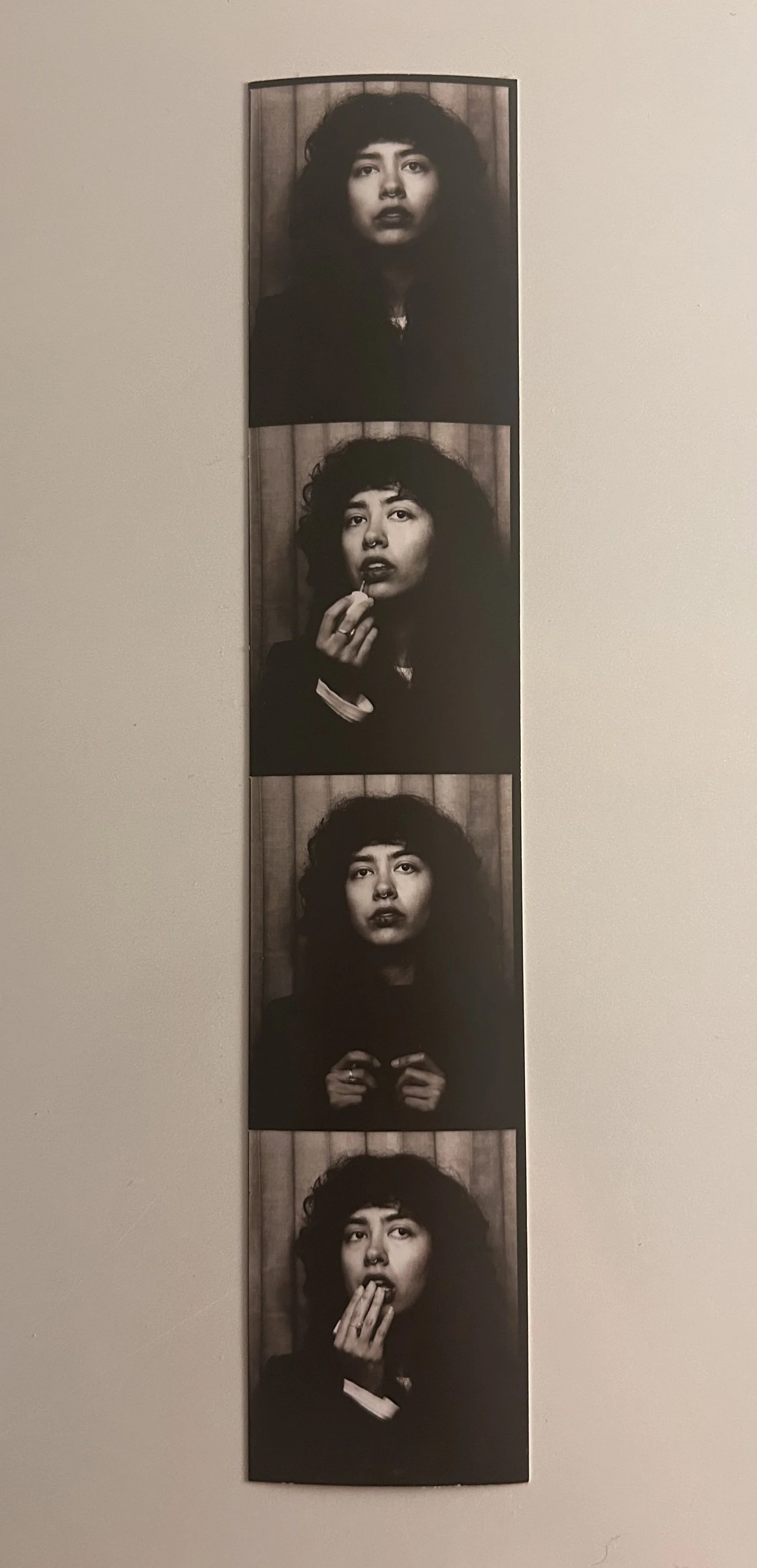
Conversation 17: Sofia Elena Rowland
On July 17th I had the honor of facilitating a conversation with Sofia for the launch of her book, Miles of Unmarked Graves. The conversation we had was a continuation of many conversations we had before—about how freeways are systemic tools of capitalism and white supremacy; about the spirituality of death and how Western culture fears it; about the plants and species that live on and around the freeway; and ultimately, about what anyone can do—including artists—to expose the tragedy of freeways in a productive manner that not only opposes such a systemic violence, but proposes a better future. Each conversation we’ve had, including the one below, was an exercise in critical thinking, and it was her poetry first and foremost that had put us on the path for thinking differently about the mundane. Detroit takes freeways for granted. What I learned from Sofia is that those things which we take most for granted, which are seemingly the most mundane, are in fact sometimes the most violent, oppressive, and political things we’ve accepted into our topography. One of the best ways to elucidate a profound sensitivity to these things—to break the walls between passively accepting and expressively critical—is through art like poetry. Miles of Unmarked Graves breaks those walls, and the dialogue it lights the way for helps keep them down.
-Danielle
The launch for “Transmissions Under the Freeway,” the collaborative project of which Sofia’s book is a part, will be on Saturday, September 26th, 5-8PM at 535 Livernois Street, Detroit.
Sofia Elena Rowland is a writer and cultural organizer based in Detroit, MI. She is interested in the fight for dominance between the sacred and the mundane, life cycles of industry and ecology, and borders between the body and the machine. Her book, Miles of Unmarked Graves, is available now through Press Here Projects.
Danielle Francisca is one-half of Nox Library.
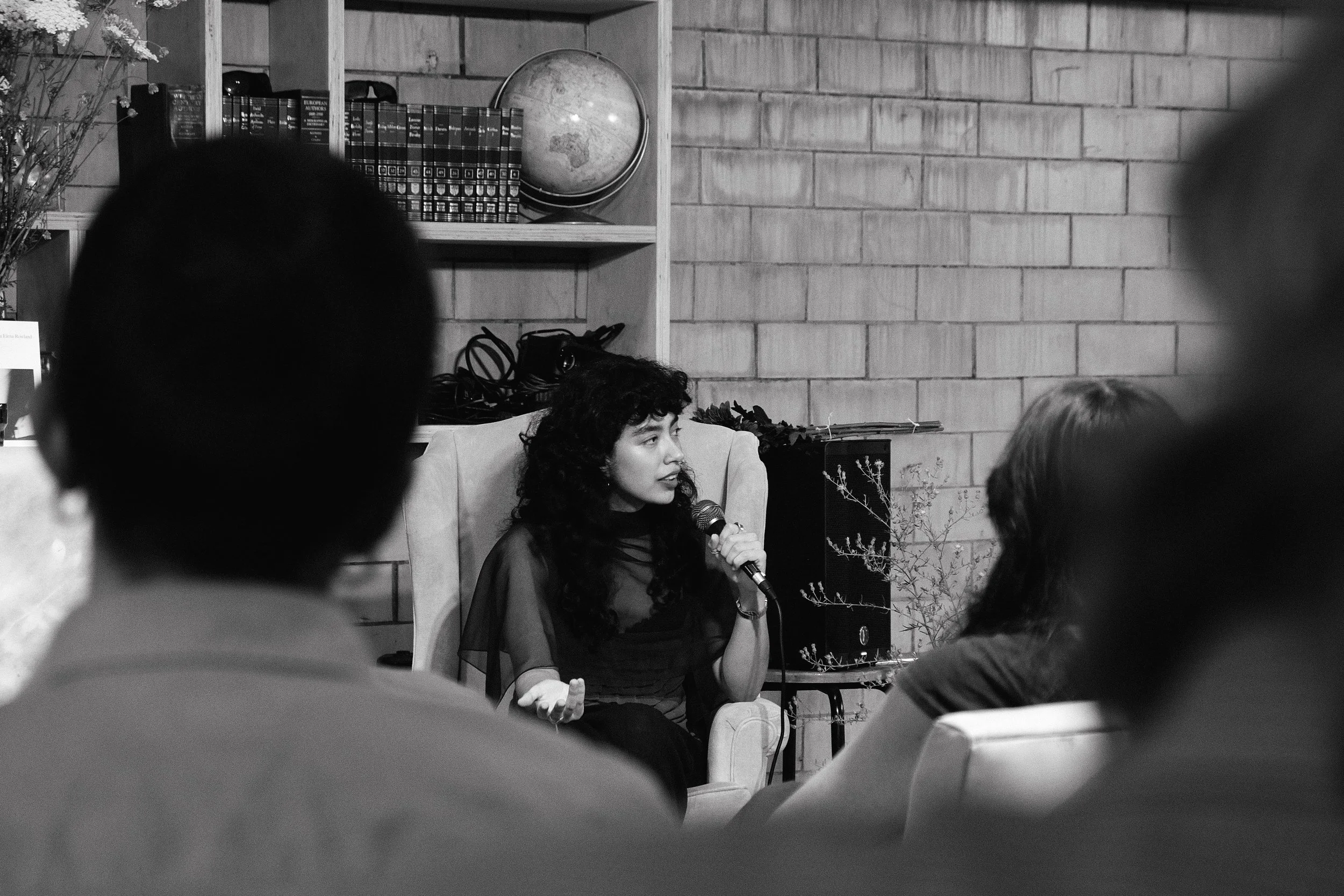
Sofia at the book launch event for Miles of Unmarked Graves
Conversation with Sofia rowland, september 2026 (Transcript)
Danielle Francisca: Hey, Sofia
…
You there?
Sofia Rowland: I'm so sorry, my computer…
DF: Oh, you're good. Happy to have you back. How are you?
SR: I'm good, how are you?
DF: I'm good. I feel like it's been more than a month since I've seen you. The book talk feels like it was last week.
How has everything been post-book talk? How has the reception been?
SR: It's been good, it's been…
I feel like immediately after it, I was like, okay, I have this weekend to process it, and then it'll kind of go away. For some reason I felt pressure to process it really suddenly after it happened, but it's becoming clear to me that it's going to continue to be processed for longer than whatever timeline I had in my head.
This whole last month of my life has been, in some ways, processing it, and also a beautiful experience getting to hear people's feedback. It made me wish I had heard people's feedback sooner, because it’s felt really inspiring.
DF: It's also part of an ongoing project, right? You're still doing work in the same area?
SR: Yeah, the project—we set out to do a couple things, and technically by me completing the book, my portion of the project has ended, but we're still preparing the box that the book will go into, and planning a release event for that. So that's still coming down the line. I also am starting to see ways that the book could evolve.
DF: I can't wait to hear about that. Before we get too deep into it—I don't want to assume anyone who's reading this conversation went to the book talk and knows what we're talking about—I was looking back at the questions I had asked you in that conversation for your book launch, and for some reason this popped into my mind: I want to understand more about how you got to where you are… I don't think I really prompted you with this beforehand, so sorry for this curveball—but why poetry? When did you get into poetry?
SR: That's a really good question.
I feel like I fell into poetry. I feel like some people who write poetry are fans of poetry forever, and then they become a poet. I sort of just fell into it—I knew that I wanted to be an English major in college, because I loved English class in high school, and I was like, I don't know what to major in, so I decided to major in English, and as part of the required courses, took an Intro to Creative Writing class. I had an incredible professor who guided us through different forms of creative writing, and when I started writing poems, I felt like it was really fun. It felt like a really good way for me to express myself, I felt like I was good at it, and I was receiving positive feedback, and so I was like, okay…
DF: You are good at it!
SR: Thank you.
DF: Which is why it's crazy to hear you say you fell into it. I mean, that makes sense, because it seems like it was your calling in some way…
SR: It's very natural, and I was lucky that it fell into my life a little bit. I just kept taking classes and that was pretty much it. I was like, okay, I'll keep doing this, and then it became something that I started doing for myself, really as a way to process my emotions and experiences, like a step up from journaling.
DF: It's another form of communication. I think this about all arts, not just specifically poetry—but that it promotes critical thinking, and that's why I think your project is so interesting, because it does push the boundaries of how we think about freeways. Which is—I mean, we've said this so many times—freeways are such a mundane, everyday thing that we take for granted. You set out on this project to understand freeways and not just people’s interactions with them, or experiences with them, but also the histories and the politics around them, while also thinking about the spirituality around freeways and what these things mean.
SR: I think I have the heart of a poet, like… I'm so sensitive. I feel things so deeply, and I love words. I love saying things precisely, but also indulging, and poetry is those things… poetry can be those ways, and allow you to be those ways. You can break rules in poetry. There are rules you have to follow when you're writing an essay, or if you're writing a short story, you have to start the sentence and end the sentence in a certain way. With poetry, you don't have to do that, and there are sometimes gaps between images and ideas, and those gaps might not function as well in another form besides poetry.
For some reason, I think of freeways like poems. There's some connection there of traveling between things, and movement that, to me, comes naturally with both freeways and poetry. But I never thought too much about freeways because I just accepted them, I think.
DF: The inevitable.
SR: As we all do. It wasn't until about 2 years ago when I was on them so much, going back and forth between Detroit and Kalamazoo, because I was in a long-distance relationship. The circumstances of my life—I found myself on the freeway more, and I started to be like, what is this place? I'm here all the time, this is a place, but it's also not…
DF: Liminal zone. Some weird in-between.
SR: And then also—I shared this in the conversation at the book launch—but I do have that vivid memory of taking piano lessons in high school, and my piano teacher describing his experience seeing the land be carved out to create 696. Hearing him say that made me realize these things—this system doesn't need to be here, and it hasn't always been here.
I tend to look at the world that way as a political person, and that's who I am. Things are this way, but do they really need to be this way?
DF: Do you feel like when you take something like that, something like freeways, and you start to think about it with your poet's hat on, and actually start writing that poetry, do you feel like you are gaining a different perspective? Or like you're reconciling with things differently and newly?
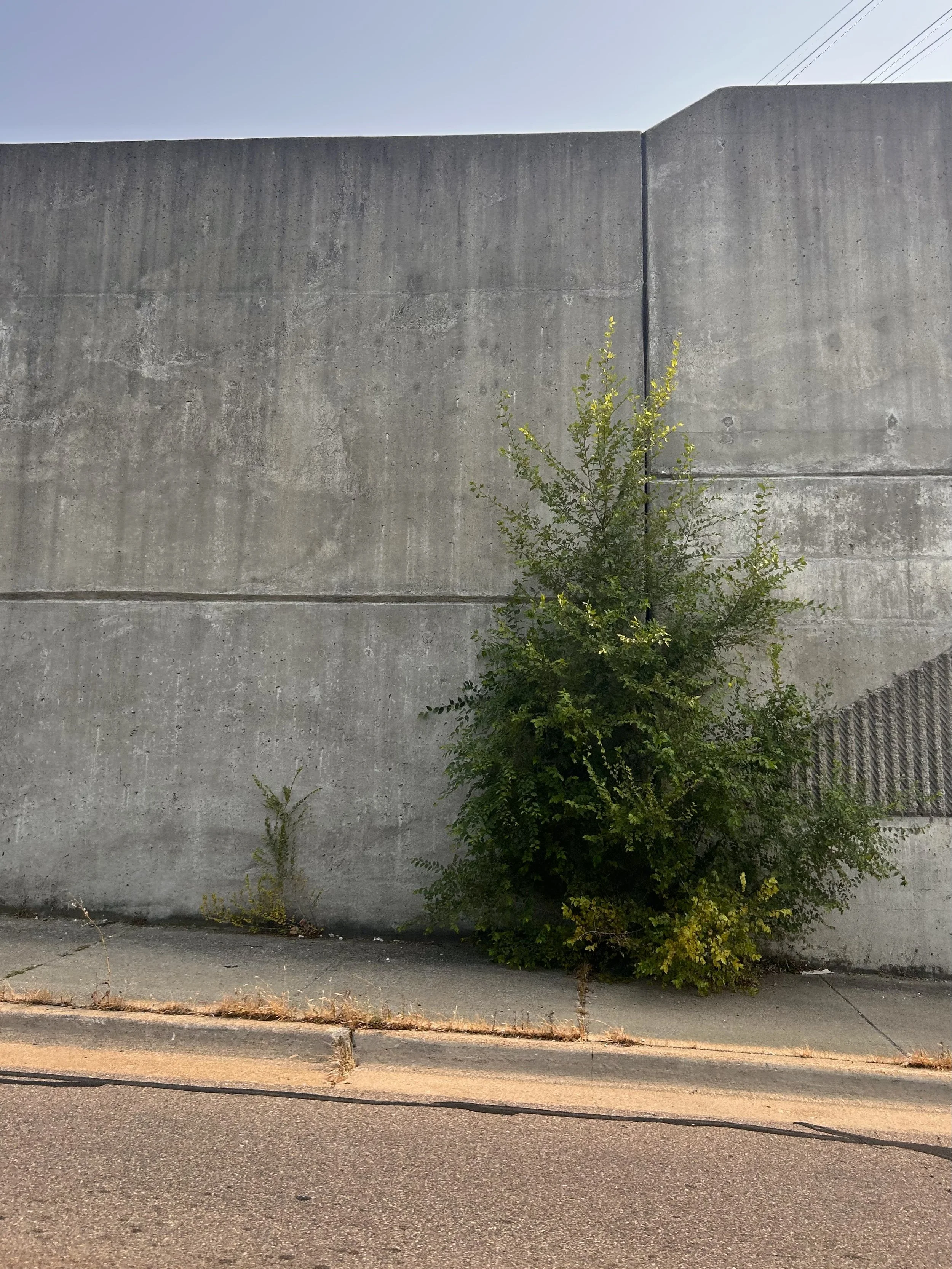
Freeway botany. Photo provided by the artist.
SR: Absolutely. When you ask what is my history with freeways, I feel like my history really started when I began to write poems about them. I didn't really know why it was freeways. It wasn't like I've always thought about freeways, or like I'm obsessed with them. It was like, I find this system kind of weird, so I'm gonna write a poem about it, because that's how I unpack and understand it. Then through the writing, I became obsessed with them. I couldn't stop thinking about them. Seriously, this time last year, if you looked inside my brain, I was constantly thinking about the freeway. And when I was on the freeway, it was ridiculous.
DF: I love this. You're the first freeway-obsessed person we have had here at Nox Library. Speaking of those thoughts that you were having in that moment, where if we looked inside your head at that time, and at what those thoughts were… you mentioned earlier there were some anecdotes that came up?
SR: Alongside the thoughts that I was having, it was mostly a sensitivity to the experience. As soon as I would get in the car and get on the freeway, I became hyper-aware of whatever I was feeling or thinking. Part of that vigilance was being curious about how my body felt when I was in the car. I felt like being in the car disconnected me from my body. Like, okay, my body is doing this thing, but my mind is sort of elsewhere. It's possible for me to travel great distances while not going through the physical effort of traveling, besides using my right foot and my hands.
So the one thing that I wanted to mention was that it sort of turned into a little bit of a practice where sometimes, when I was driving, I would think, okay, if I really want to focus here, I need to connect my body to the car… so then I would imagine that my body was the car. This sounds crazy, but it's kind of like meditating—I just sink down and pretend the bottom of my body is the bottom of the car, and then I would notice that I felt like we were one.
DF: When you introduced your book to me, and when I read it, on top of the conversations that we had, I was also thinking about freeways in so many different ways which I felt became really beneficial to my understanding of the city and economics, and why we have freeways. Which, you know, I have thought about before, but now beyond the fact that they razed these thriving Black neighborhoods to build these freeways just so they can accommodate middle-class white people to come into the city to work.
Beyond that, it's just the concept of freeways as being this thing that controls our time, and controls the way that we transport our own labor when we're driving to work. One of my favorite things that you and I talked about was, they didn't build freeways so that we could go see our family faster, or so we could have easier access to our families or our friends that live far. No, they built freeways so that we could transport goods for sale, or transport our own labor, which we are also selling on the market. Thinking about freeways in this respect has been really kind of interesting to me.
Your book is called Miles of Unmarked Graves, so there is this component around death as well. I can let you speak more on that if you want.
SR: First of all, I was so grateful that you connected those dots about the economic part of it, because I hadn't thought about it exactly in that way, either, and it's so true. It's so important for us to recognize the physical structures that facilitate these larger systems that feel sometimes like they're happening all around us without us, even though they are dictating the way that we live. Yes.
The title I've been thinking about a lot recently. I've been having conversations with people post-launch, and yeah, a lot of it has to do with what freeways destroyed in order to exist—the thriving communities that are often Black and Brown communities that were deliberately destroyed in order for the freeway to be there.
Also the death that occurs, and the potential for death that occurs on the freeway that I think we live in denial of. It's just a really dangerous place to be, on the freeway. It's so dangerous, and sometimes I'm like, am I really qualified to be operating this large machine?
I had this phrase that I was commuting through a cemetery. I was just on my way to work, and just pretending like I didn't just see a dead deer…
DF: I love that phrasing, “I'm commuting through a cemetery.” You're forced to confront the reality… it's a metaphor, but there's no better way to put into words the reality of what freeways have done to our land, people, animals and nature in the past, but also in the present, and what they're gonna continue to do in the future. Whether we talk about literal deaths, or we talk about the destruction of communities, or if we just talk about how our planet's dying because of the plethora of cars traveling all the time. And also the general death of treaties that were not honored in this land.
SR: One of the poems… I have the book right here—I think this is one that I read…
They carved out the houses, drained the lake to build a parking lot,
went on towards billboards, concrete valleys, buried treaties.
DF: I want to applaud you—and I was thinking about this when you were mentioning how you fell into poetry—because there're so many ways to contribute to the world, and I think one of the best ways people contribute to the world is by utilizing their skill. I feel like through your writing, you contribute. Your book launch is a really great example, because people were so invigorated by what you were talking about, and by what your book touches on. In that room while we were having that conversation, so many people turned out and then so many people had questions. I think it's because art, poetry, and specifically your book was communicating these ideas in a way that encourages people and welcomes people to think critically about these things, which opens a ton of doors for what more can be done.
SR: Absolutely. Thank you for saying that. That was so sweet. I mean, and you did, like… people had so much to say about you, too. That was such a special thing, and I really appreciated you having that conversation with me, because it was… it was perfect.
DF: Aw, look at us hyping each other up. Documented, too.
SR: I appreciate you saying that. I think sometimes I do get a little down on myself. Because it's like, man, this is really… this is kind of depressing…It's sad, but I do feel like I'm okay with going there for myself, because I feel like it allows other people to go there, too. I have been thinking a lot recently about how there are so many things to experience in the world, there are so many potential experiences and lives to live, and sometimes I get sad that I can't experience everything, but I have recently felt comforted by the perspective that through others, I get to experience.
DF: That's lovely.
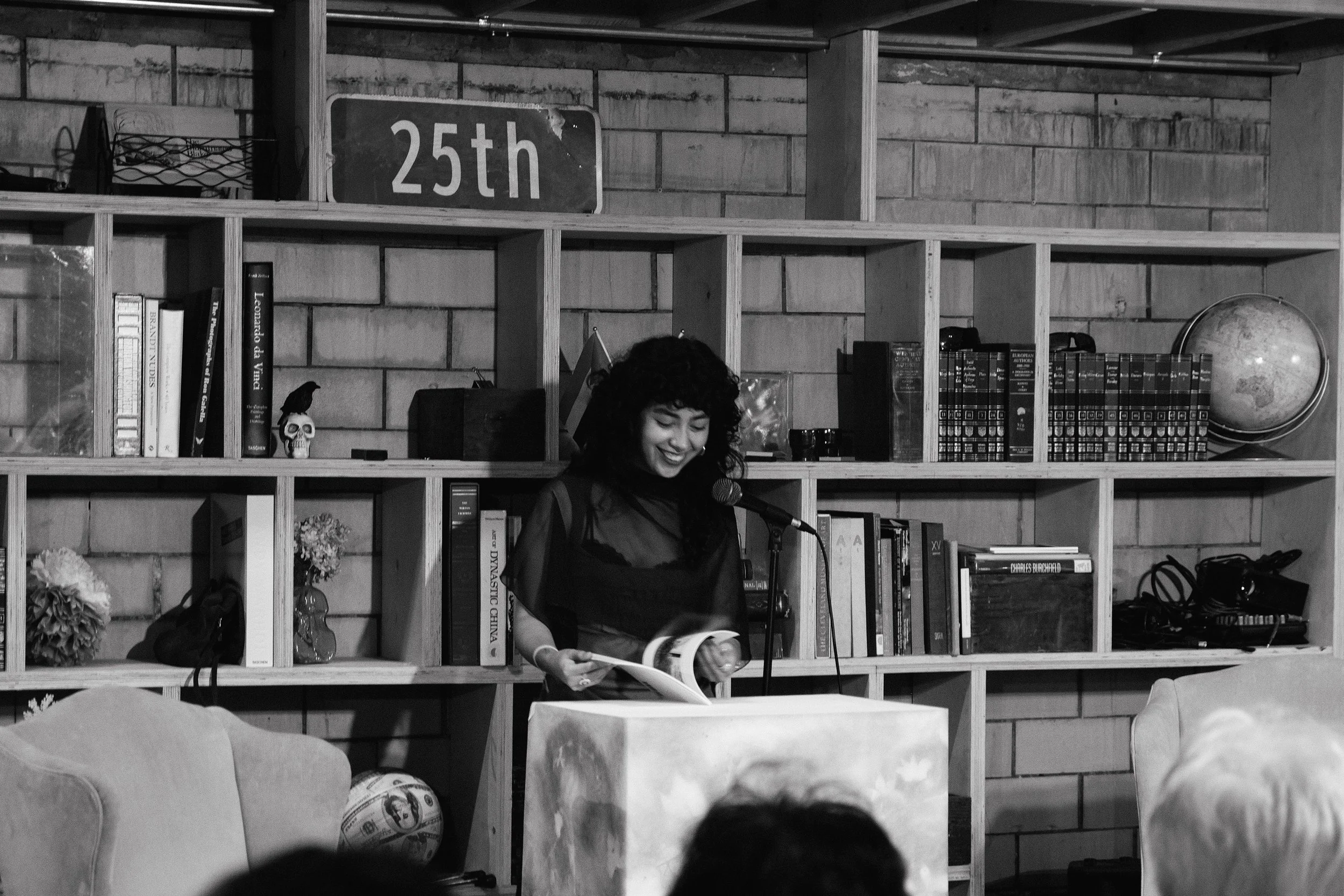
Sofia reading poetry from Miles of Unmarked Graves at the book launch on July 17th.
SR: I don't get to literally experience everything, but when I allow myself to feel like we are all part of the same organism, then I feel like, okay, this is what I'm supposed to do, and other people are supposed to do other things, and we can come together. I do feel like that is the beauty of art.
DF: Which really brings home the point that art is an essential part of the ecosystem as well, of our ecosystem as human beings.
SR: Absolutely. Yeah.
The one anecdote that I wanted to mention that I forgot to, was how one of the parts of the book references: the safest place on the road/is behind the person driving recklessly/that way you can see them coming/the safest place in the world must be your eyes on the back of a man's head/that way you can watch him leaving.
DF: Hmm…
SR: It is important to me that I mention that there is a feminist lens to this book, because that's a really important lens through which I see the world. The seed of that poem was planted years ago when I was living in Oaxaca,Mexico, and I was walking down the street at night, going out to meet my friends, and there was a group of men that came out onto the street, and I did the thing that all women know, which is scan for potential signs of danger, and evaluate the situation, which was when I had the thought, the safest place for me to be is behind this group of men, so I can see if they try to approach me.
At that moment, I remember thinking, this is like driver's training, when they teach you that the safest place to be is behind a threat, behind a car that's driving recklessly…
I want to reference that, because at all times we are swimming through these forces that are unnamed, and part of why I write is to name them. That's a force to me, that's connected, like a freeway and the patriarchy are connected to me.
DF: They certainly are. Freeways are a very systemic thing. Freeways are a system, and, naturally, that system is a patriarchal one, because it's not just a system in and of itself alone, but it's a part of a broader system that's actually quite patriarchal, and a lot of that has to do with policies, and economics…
The way that you compare driving to watching the back of men's heads as the safest place to be—it's crazy when you think about how easy it could be to lose control of a car, and with how precarious it can be to be a woman walking alone at night when there’s a group of men around…both scenarios are life or death sometimes.
SR: Yes.
DF: That's also a morbid thought, but I think shining light onto it, and being able to have that conversation—honestly, I feel like we are barely at the start of a conversation about how freeways systemically are tied to patriarchal issues and gender-based issues. That's something to dissect.
SR: Definitely. Definitely. The way we design the world is not neutral. And also, who gets to design our world is not neutral.
DF: I don't know how else to make a stronger point of that than your poem that you just read…sure we could write a goddamn research paper about this, right? But four lines of poetry bring that point home like nothing else can. It communicates that, but also is a way of getting the readers to experience it, so some readers who might not actually experience that—maybe men—may be able to understand what that must feel like.
SR: Hopefully, people who have had that experience can feel represented, and it resonates with them, and maybe gives language to an experience in a way that they maybe couldn't give language to themselves. It also illuminates something for someone who might not be able to see it, and I think both of those experiences are crucial for imagining a different way to be. And pausing for it…poetry takes time to read, too. You can’t just skim it, necessarily. I like that, too. I also like that it's slow, but it also can cut straight to the heart of something. I can be a long-winded person, and I appreciate that in poetry, I can say things straight up, sometimes in a way that it might otherwise be hard for me to say…
DF: Poetry's like when you hit a gong, and the vibrations just roll through real steeply and slowly, and you just kind of feel it in your core.
SR: A beautiful description.
DF: Do you have another event coming up?
SR: We're planning within the next month or two to have a launch event more broadly for Freeway Botany, the project as a whole. So that will be the brochure and then the box, which will include my book and other objects.
DF: Thank you, Sofia, for having this conversation again with me.
SR: Thank you!
End.