Conversation 16: Zahra Almajidi
A sea of red. Red shirt. Red banner. Red smoke. Red paint. Red flower poppy. Red sign. Red keffiyeh.
BIDEN BIDEN YOU CAN’T HIDE! WE CHARGE YOU WITH GENOCIDE!
Red flowers on the lawn. Red, white, green, and black waving around the White House.
I’ll never forget these sights. Just as I’ll never forget every photo and video I’ve seen from Gaza in what is known as the most live streamed and viewed genocide in history.
Zahra and I shared our memories from a 24 hour bus ride we took together to DC in the following conversation. We also discussed Zahra’s family story, their displacement from southern Iraq, how that has shaped how she feels about protest, and how she uses her practice to preserve her cultural heritage while creating her own contribution to the lineage of craft history.
I don’t take this conversation lightly. We are in a renewed time of artists, intellectuals, and workers of all types being fired or blacklisted for supporting Gaza and affirming their political beliefs. That is why these conversations are so important, to archive that those in the belly of the beast of empire are against the genocide in Gaza. That working class people in this country and all around the world do not support the overarching narrative that may shape how this history is written. And that despite displacement, the culture and history of diasporic people will persist as long as they are passed along through movement, photographs, illustrations, written down, sung, played on instruments, and/or made into objects. Culture preserves our ancestors, recovers our souls, and creates our future.
-Heather
Zahra Almajidi is a visual artist and metalsmith raised and based in Detroit, MI. Utilizing both traditional metalsmithing techniques and CAD/CAM processes, her work explores the ways in which objects and adornment allow displaced people to continue to uphold and practice their craft traditions while living in the diaspora.
She has worked at several art fabrication spaces in Metro Detroit including Wayne State University where she received her BFA in Metalsmithing, Lawrence Technological University where she briefly served as shop co-manager, and Cranbrook Academy of Art where she received her MFA in Metalsmithing and was awarded the Cranbrook Art Director’s fellowship and the Director’s Award.
She has taken part in the 2021 Incubator Residency program at Talking Dolls Detroit, the Artist + Residents Program at the Arab American National Museum in 2021, and the Winter Residency program at Penland School of Craft in 2024. She’s also dedicated to maintaining an active studio practice and regularly exhibits work.
She is currently the Central Materials Lab Coordinator at Cranbrook Academy of Art.
Heather Mawson is one half of Nox Library.
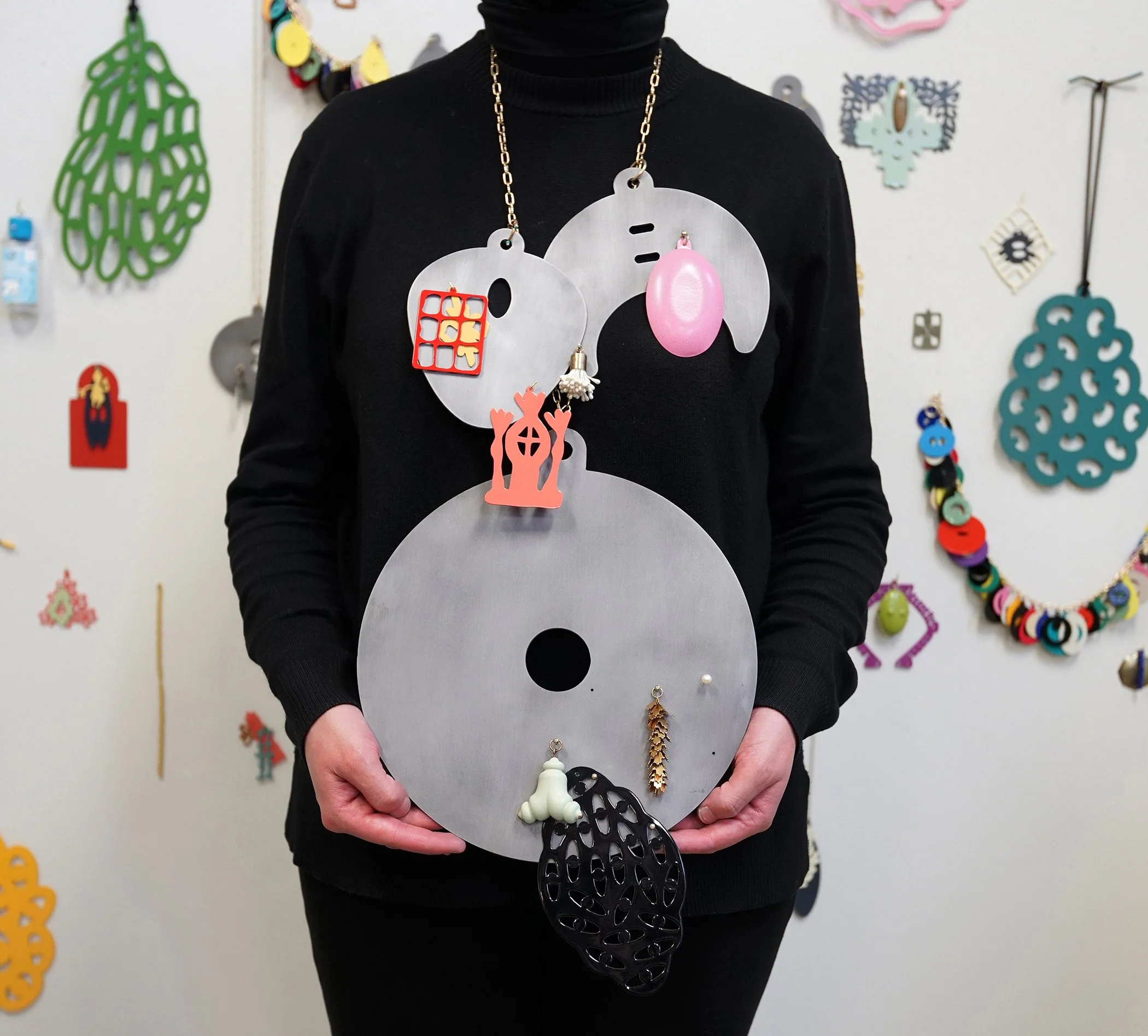
Collectors, Mixed (Steel, brass, 3D printed PLA plastic, pearls, plastic flower stamens, beads), 2021. Photo Credit: Bonnie Xue
Conversation with zahra almajidi, august 2026 (Transcript)
Heather Mawson: Hi, Zahra. Thanks for joining. I'm actually joining from Talking Dolls.
Zahra Almajidi: I was wondering if that's where you were.
HM: I know you're familiar with the space because you were a resident here, right?
ZA: I was a resident in 2021, right after I graduated from Cranbrook.
HM: I remember your show that you had here.
ZA: The show happened… almost a year… actually, a little over a year later in 2022.
HM: Such a small Detroit art scene.
So, I wanted to go back to a memory I have with you, which not a lot of people would know about. We took a 24-hour round-trip bus ride, I think it was 24, maybe 30-hour bus ride to DC on June 8th, 2024, and I think it all happened within a week’s notice. We saw each other at a protest that was happening in Hart Plaza. I remember seeing you there and then I think we heard that there was a bus leaving the next week, or something like that? This is my memory, and then you'll have to tell me if…
ZA: What it was, was I think you either shared it on Instagram, or I shared that it was happening, and then I asked you, or you asked me, are you going? And I was like, maybe, I don't know, I don't want to go alone, and then we talked about it in person at Wayne State when the campus cracked down on the encampment. There was like a day of protest that was happening on campus and I'm like, well, do you want to go?I'll go if you go, kind of thing. I think that's when we agreed, and I was like, okay, tonight I'll book the ticket.
HM: Just to give some context… June 8th marked 8 months of the genocide in Gaza, and the 54th anniversary of the occupation in Palestine, so that's why they were trying to do it on June 8th. So we took a bus ride out there and around 100,000 people showed up, and we all wore red to create this “red line” around the White House. It ended up being like 2-miles long. We were demanding a ceasefire and there was a lot of energy, and for us, who took a 24-hour bus ride out there, we did that action, and then we jumped on a bus and then came back.
I feel like when we did that, we didn't really talk about the experience, our perception of what happened, and our feelings about what happened. I'm curious how you remember that day and why you think it's important to speak up and step out about this stuff in general.
ZA: I mean, like you said it was 24 hours…it was a blur. We got on the bus, woke up in DC, immediately walked to the gathering area, and then protested. Then they're like, okay, back on the bus now.
HM: Have you ever done anything like that before?
ZA: No.
HM: Neither had I.
ZA: No, that was the first time. I think the reason I wanted to do it was, like so many people, it's very easy to feel hopeless, or feel very isolated in a time of… like they call it, the most live-streamed genocide. And you know, you’re like well if enough people see this, then clearly someone will stop it. Or if enough eyes are on this thing, then maybe we'll get the sympathy of someone. But like you said, it was 8 months, and it just seemed to not have any stopping point and there seemed to be no end in sight. So I think, or I assume you felt the same way, of like… I want to do something, I don't know how to do something, I don't want to stay at home feeling helpless, and this was one way of being in community with a lot of people who felt the same way.
HM: Totally.
ZA: We weren't naive to think that our action would immediately stop the genocide. It was just coming together to just let our voice be known. That we are emphatically against this horrific act that's happening.
HM: Yeah, and we're willing to stop our own lives and show up. Like you said, I remember there was a point made in speeches that we knew that nothing would happen right away, but that we would have to continue to fight, to step up and speak out.
ZA: It was a really interesting time. I remember it was right before the presidential election. So in DC, there were some presidential candidates, at least the Independent and the Green Party candidates speaking as well. That was really interesting, seeing them come out to this protest and speak at the protesters. I think Jill Stein was there and then one of the other candidates who was running. So, the election was also on a lot of people's minds because at the time, this was Joe Biden's presidency, you know? But we knew that looming in the air was a potential Kamala Harris or Donald Trump presidency. So I think tensions were also really high because of knowing the election was coming up.
HM: And we knew that we had to build momentum and energy to show politicians that this is something their constituents care about.
ZA: Yeah, like this isn't something that we'll just forget about easily, or get distracted from.
HM: I'm thinking about how this connects or doesn't connect to your art practice. I've never asked you about this, but do you think your beliefs or what you've spoken out for has impacted your art practice? I mean impacted by either seeing that in the studio or through the presentation of your work or where your work is situated.
ZA: The current work I'm making now is very much about this group of Arabs called the Marsh Arabs, which my family belongs to, and the reason at least my family was directly displaced was because they staged an intifada, or a rebellion, against Sadaam’s regime. So my family was displaced because of an act of protest themselves. I think that's kind of like a full circle kind of moment. They lived under this oppressive regime. And they were displaced because they resisted that regime.
HM: They were from where?
ZA: Southern Iraq. In the marshes. A specific area called Al-Chibayish. But because of this act of rebellion or intifada, over a million southern Iraqis ended up being displaced. Which led to this massive refugee crisis that occurred. And so in many ways It'd be wrong for me not to be politically active and politically minded knowing my origin—I was born in the refugee camp—so knowing that I was born in a state of displacement, in a state of not necessarily homelessness, but houselessness, this state of transition. Knowing that the work I make is about people in displacement, people in the diaspora, and people in the diaspora continuing the craft traditions of cultural ancestors. Knowing that… I think the protesting kind of comes in. Not even just protesting, but political activity and advocacy for the marginalized.
In leading up to this conversation this week, I remembered a memory of going to a protest as a kid. My dad took my brother and I to a protest in 2003, I think around the time that the Iraq War started.
HM: It was here?
ZA: It was in Dearborn. I remember it was a small gathering of people. So from a young age, I was in spaces of protest and of political spaces.
HM: Yeah, how could that not inform the way you act and think at this stage?
ZA: I mean, it's one of those things that I know a lot of people are putting themselves in the line of harm or at risk, but in many ways, I find protesting to be the least I could do, you know? The political activity that I'm part of… I almost owe it to people to give my voice to these causes or movements. I know what's at risk, and for better or for worse, I’m in a privileged enough position where I can be present in these spaces.
HM: I very much feel the same way.
You already hinted at it, but I was looking at the information for your next show—which is a solo show, at Playground Detroit, and the opening reception is Friday, September 4th, 6 - 9pm—I'll be there, very excited for it, but when I was looking at the information you prompt this question, which I'm going to pose to you to try to answer, which is, how does one build upon the craft and design traditions of their ancestors to forge a connection to their displaced culture?
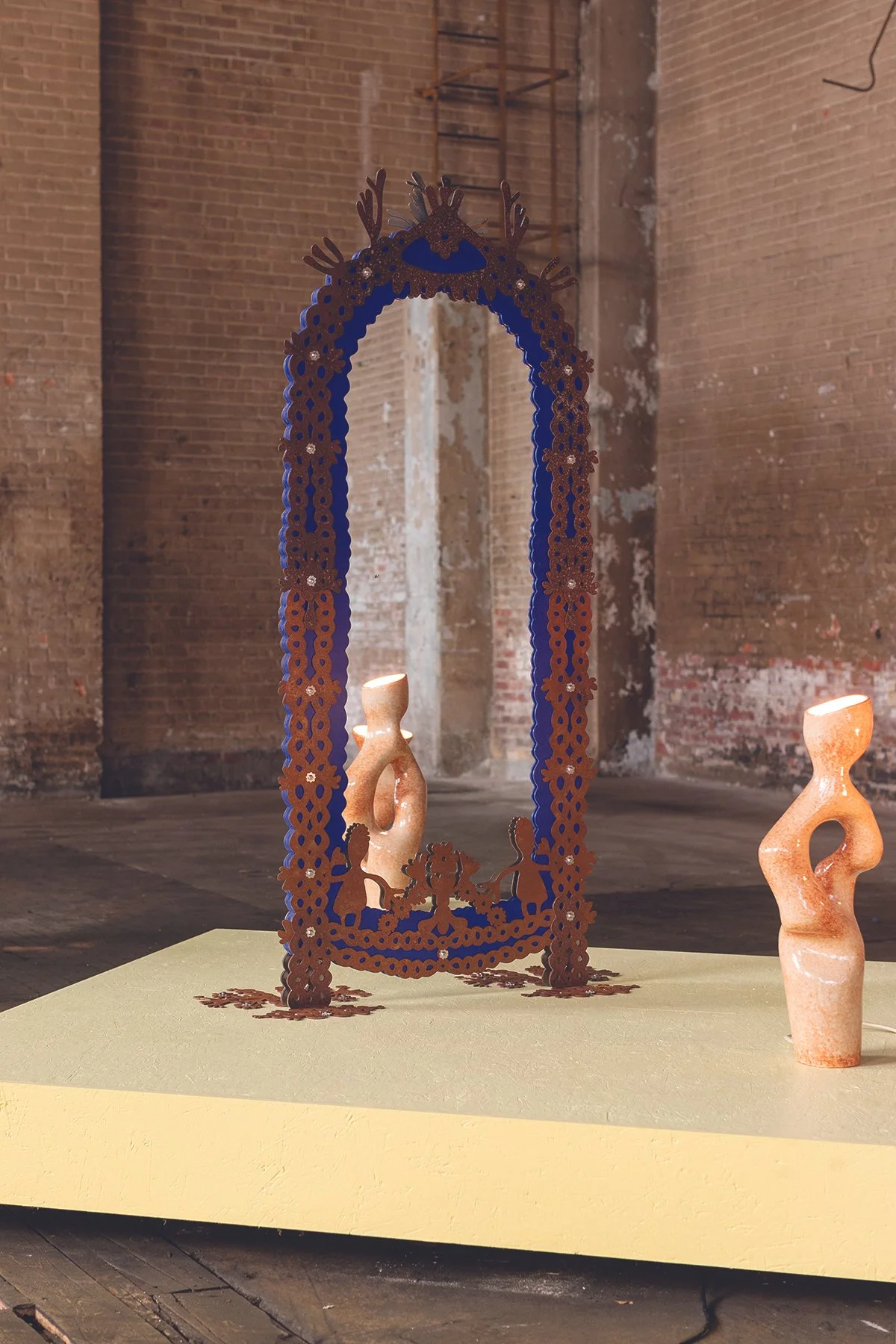
Mirrored Histories, Mild steel, MDF, mirror glass, stainless steel hardware, 2022. Photo Credit: Clare Gatto
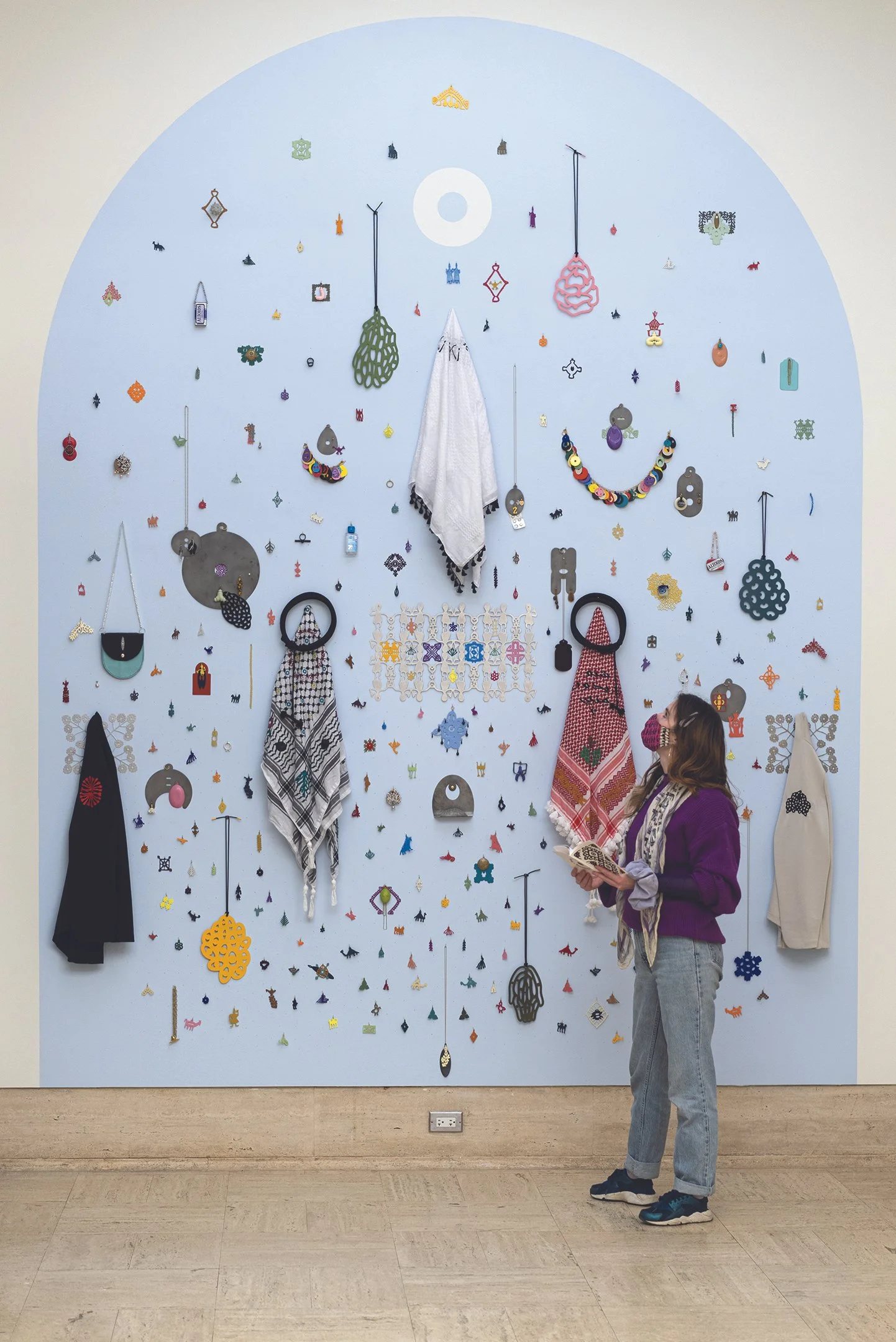
Where Are YOU From? Mixed Steel, brass, silver, gold, 3D printed plastic, hand sanitizer, Vaseline, Dramamine blister pack, paper, leather, silk cord, fabric, thread, pearls, beads, lotus seeds, gemstones, stone, plastic flower stamens). Dimensions Variable. 2020-2021. Photo Credit: Brian Kovach
ZA: Growing up, I was always hearing about this place that my family is from, and I was made to think that it was very significant, but I just could not feel that connection in any way, and it wasn't until I started doing my own research about the region that I came across those rugs. The Marsh Arab rugs, which have become the central focus of my work, and is basically what my work has been pulling from and expanding on. From this, I've finally started to get some sort of understanding and grow more connected to the culture through these craft objects specifically.
I think that's why I posed that question, because knowing that there was such a strong craft and material culture in the region that was effectively wiped out because of political oppression, as someone who is a craft artist, who came upon it not because of wanting to get that connection, but inadvertently ended up in that space, or that spot, It's been really interesting to be able to gain that connection through my craft, and through exploring the craft objects. Also, I make it very clear that I'm not trying to recreate the objects. I’m wondering how I can, through my own cultural positionality, with the skills and techniques that I've gained, and my experiences, how I can expand upon and grow from these craft cultures and traditions.
There's the silver work, the fiber arts, and then there's the ceramic work. A lot of the craft objects. I should note, they're decorative, but they were first and foremost made out of necessity. So the ceramic objects that were made were ceramic ovens. Then there's the fiber rugs, and blankets. Everything was made because there was a need for it in the home. And it just happened that they were decorative/ornamental objects. I think that's really interesting, when something that is made out of necessity is allowed to be decorative and ornamental as well. Because now, craft is seen as kind of… I don't want to say selfish, but almost like an…
HM: I agree with you. I think a lot of people perceive handcrafted objects as indulgent or for people who have money, or…
ZA: Yeah, as something of privilege. Like, who does have the privilege to be able to make a ceramic object, or even collect these objects in their homes? So people made these objects because they needed it, because it was made out of necessity.
HM: But also, not just because… they needed it… they wanted to represent who they were. From talking to you in your studio, I know that so many of the rugs have symbols of things that they were surrounded by. I don't know if you want to talk more about that.
ZA: These rugs that I'm referencing, they're called Marsh Arab rugs or blankets. I’ve found a few different resources that expand on what these rugs are, but through my research I've come to learn that the blankets themselves were referred to as wedding blankets as well. When two families come together in agreement for their families to join in marital union, the women of the family would agree on colors and themes and shapes of the rugs, or of the embroidered forms on the rugs. They (the two families) would go their own separate ways and they would start embroidering the woven rug. Then they would come together and they would stitch it down the center. So you can really identify these rugs by the very visible stitch down the center, and oftentimes the bride-to-be is working on her own rug that she will live with in her home. You'll see that they're kind of symmetry in the rugs but they have an asymmetrical symmetry that's happening. Like, they have very similar motifs, but each family has their own kind of approach to the motif.
A lot of the things they were representing were plants, animals, and the architecture of the region. It's really hard to date the rugs, but you could tell by mid-century, when artificial dyes become more commonplace, you could see the colors becoming very, very vibrant. Before that, they were more neutral colored, and then you start seeing very vibrant fuchsia and turquoise in the rugs.
HM: As you mentioned, you don't attempt to replicate them. You're thinking about how you can reference this history and these objects, but then put your own spin. You’ve used so many different ways. Do you want to share how you’ve approached doing that?
ZA: Yeah, I was so obsessed with these things. I started pulling the forms from the rugs. I would save images, and would trace the image, and then scan it into the computer, digitize in Illustrator, and then I started making charms out of these things. As a jeweler, that made the most sense to me at the time. This thing that is a very static object has now been brought to life… brought back to life, and is now worn on the body. So it's no longer just situated in the home itself, but it's now being able to be carried around from space to space.
HM: Calling back to the kind of displacement, transition, of not being in one location—it's able to move with you as you leave..
ZA: Yeah, yeah. So that charm has become more hybridized. A lot of the forms I'm making now are very hybridized, and I think in many ways, that kind of reflects my own hybrid being. I'm starting to bring things together, things that are from the rugs, but also different, motifs and different shapes that then come together. I started making frames, and I started making what I call wall rugs, and that was the basis of the work I was making at Talking Dolls residency (2021), and I expanded on it when I was doing the Arab American National Museum residency (2021). From there, I started making larger furniture objects and design objects, and so it went from taking the small objects from the rugs to now making new design objects, the objects that you could live with, the objects that you can't ignore in your home. When I started working on the work last year for my solo show at the Sculpture Center (2025), I went back to the simple form, and started making that into a frame itself, as opposed to making a frame of multiple objects. I started expanding the thing and making the simple object into a more complicated form itself.
HM: Hmm. It's amazing. That's why I've always been… well, there's so many reasons why I love your work, but really because you dive so deep into one culturally/personally significant object to you. I feel like sometimes people would feel that by doing that, you're limited, but I feel like within your practice, it's such a clear example of how it's not limiting at all. It has actually done a lot for you to focus on the Marsh Arab rugs and think about that so deeply.
ZA: Oh yeah, this archive that I have, the digital archive now is over a thousand forms that I've just been expanding on. I tell people I have more ideas than I have time. Like, I will never run out of ideas with this stuff. The nice thing too, is I'm just making… I have this, like, innate need to make the work, so I've just been making it, and every time I make the thing, I try something new. So it's been really fun just exploring all the different ideas.
HM: I'm curious, can you share some longer-term plans or dreams for what you want to make, and what those look like, or what they refer to?
ZA: I want to go back to jewelry. Jewelry is my first love. So, along with the rugs, there are also these things called Marsh Arab Silver Objects, and a lot of them are jewelry forms that I've been able to find, and I've actually been able to collect a few. They're engraved silver forms that are then filled with this material called Niello. It's sulfur mixed with silver, copper, and lead that are mixed together to make this very black, very graphic appearance. These are more… I don't want to say realistic representation… they're less stylized, I should say. They still have the motifs or the architecture, and then you have the camels, palm trees, and canoes. As opposed to the rugs, which are very stylized, due to the nature of the softness of the fiber. So I've been just spending time with the silver objects, and I'm thinking of how to kind of respond to the objects in many ways. Kind of like a one-to-one response. Again, not recreating the thing as it is, but just, like, my own response to the object with the materials and the skills that I have. Moving forward, I'm really excited about that. And I've already started doing some tests.
One other thing I’d like to explore, again there’s all these little pockets of ideas, but I was in Paris last fall, and I walked into a vintage shop, and I came across this ring. I could swear it had a Marsh Arab form on it. I asked the shopkeeper about it, and she said that the designer was pulling from a lot of “oriental” and “exotic.” So, I started looking up this designer and they were using design elements from Southeast Asia, and design elements from the broader Arab world, and no two objects look the same, so it was a very confused aesthetic. The ring itself was really interesting, because I could swear I could have pulled that form from a rug itself. So I'm wanting to kind of recreate or respond to that ring. Basically, remake the thing that I… I didn't buy the ring, obviously. I was like, I can't buy this. It also didn't fit. It was… it wasn't the prettiest ring.
HM: I'm curious, was the designer from that region?
ZA: No.
HM: Do you think that'll be a part of your response in some kind of way?
ZA: Maybe. The designer is Scooter Paris. They don't really make work anymore, but they were popular in the 80s and 90s. If you look them up, you'll see the broad range of just really ugly jewelry that they were making.
HM: I think it gets back to that “oriental” idea that people have, a very colonial idea of people—including artists, creatives, designers—who look at a region and lump many cultures together and feel like they can just take it in order to put it in their own work.
ZA: That’s why appropriation… I mean, it's bad in so many ways, but it's so lazy. It’s just pulling from so many different things, it doesn't have one true voice or visual language. It's a very confused amalgamation of all these different things.
HM: Totally.
I feel like that's the end of our conversation, but are there any last things you were hoping to mention or talk about?
ZA: I think one… with a lot of the work I've been doing, I've also been using images. The images themselves are pulled from articles, Reuters or Al Jazeera or whatever on the Marshes. Sometimes I do a side-to-side, like, pre-ethnic cleansing, post-ethnic cleansing, and then I do quite a bit of photo filtering. I started when I was first doing the photo frames. I was using images of myself and placing myself in the rugs and stuff. But I also now have started using images from articles written about the devastation of the Marshes in the work itself—it's been interesting. I have a folder of all these images of pre, post, and now. Post the follow-up of the Saddam regime and now as the water is coming back to the marshes.
HM: So interesting. In my work I use appropriated imagery and often times I double or layer images together. I see that as this kind of collapsing of time, and these images become indicative of this moment, and how time comes from the past, the present, and the future. Do you see it in that way? when you're…
ZA: It's confusing, and it's disorienting in many ways, because you're like, I don't quite know what I'm looking at, like when is this, or what is this from? I remember your work at the Boyer Campbell show, and the way that you were using clips from news shows, segments, and articles.
HM: Totally.
ZA: So that's something that I've been exploring—the use of imagery. Live and real imagery in the work, as opposed to the craft object side of it, but there's also appropriated imagery as well.
HM: Which is super relevant. Thinking about how images collapse on one another. It's such an interesting addition to the objects in your work.
ZA: Yeah, and it's really interesting because you can see who's taking the images through an anthropological lens, or an orientalist. There’re some that are sensational, the posed ones, and the people who are trying to win Photo of the Year or whatever. Versus the ones that are just literally a snap and shoot situation. That's also been interesting to see the more, like, sensationalized versions.
HM: Yeah, thanks for sharing that. I'm glad you added that, because it creates even more nuance to your work in terms of your connection to craft, craft history, object making, but also image making. There are so many layers to your work. That's why I love your work so much.
ZA: I appreciate having this conversation.
End.
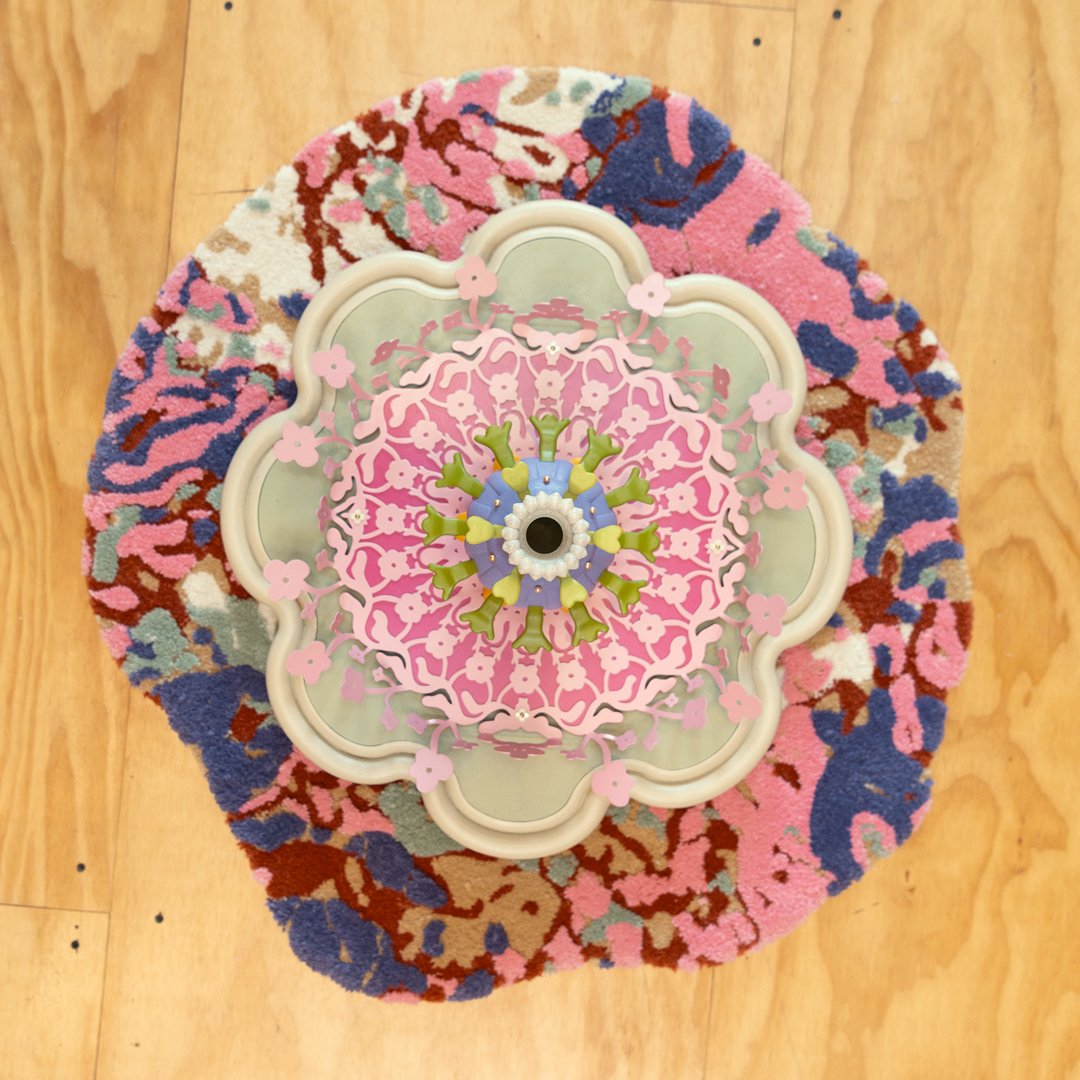
Gathering 3, Rug (yarn), table (plywood), tray (stainless steel, brass, SLS 3D printed plastic feet), vessel (3D printed plastic, brass, pearl), 2025. Photo Credit: Brian Kovach