Conversation 13: Aiko Fukuchi
The brain holds memory as a spill drawn up by a sponge; Soggy and sopping, it leaks and dribbles out, drips down the spine in search of a joint or muscle to burrow deeply. It will whimper and shake in the blood. It will surface with a shift in weather to sob with the rain and breathe into a swollen summer heat.
- Aiko Fukuchi, opening paragraph of The First Mirror is a Night Sky
As I write this introduction, my fingers are cold while tapping on the slick keys. I'm sitting on a metal seat with a metal back that has a cushion on it (which barely helps soften its hard nature). I can hear the gusts of spring winds that are tossing the long blades of my neighbors grass, overgrown, but just the right height for all of the insects that are awakening and exploring after a long winter. I’m hungry and there is a ringing in my ear that I can’t ignore, my shoulders are slightly too hunched, I’m reminded to roll them back while I think about how the brain holds memory as a spill drawn up by a sponge; Soggy and sopping, it leaks and dribbles out, drips down the spine…. As I read Aiko’s writing, I’m reminded of my body, how I’m feeling, my surroundings, and how history shapes every part of our world, including ourselves.
In our conversation, Aiko shares that even from a young age they have used writing to navigate their emotions, sensations, and feelings in response and to process the external world. They also describe the ways that working within the environmental justice movement continues to shape their perspective and writing. In the last part of our conversation, we get into AI and its impact on our lives and the world; like every conversation I’ve had about AI this year, there ends up being far too much talk about, so I had to shorten this transcript for publication. To Aiko this conversation has a silly ending, but for me, to leave you, our reader, with anger, a complex emotion that is often sparked by injustice, hopefully emphasizes how deep and serious the topic of AI continues to be.
-Heather
Aiko Fukuchi is a writer and community builder based in Detroit Michigan. They are a student to social movements including transformative and environmental justice. Aiko’s chapbook, ‘The First Mirror is a Night Sky’ was published by Bulk Space in 2023.
Heather is one half of Nox Library
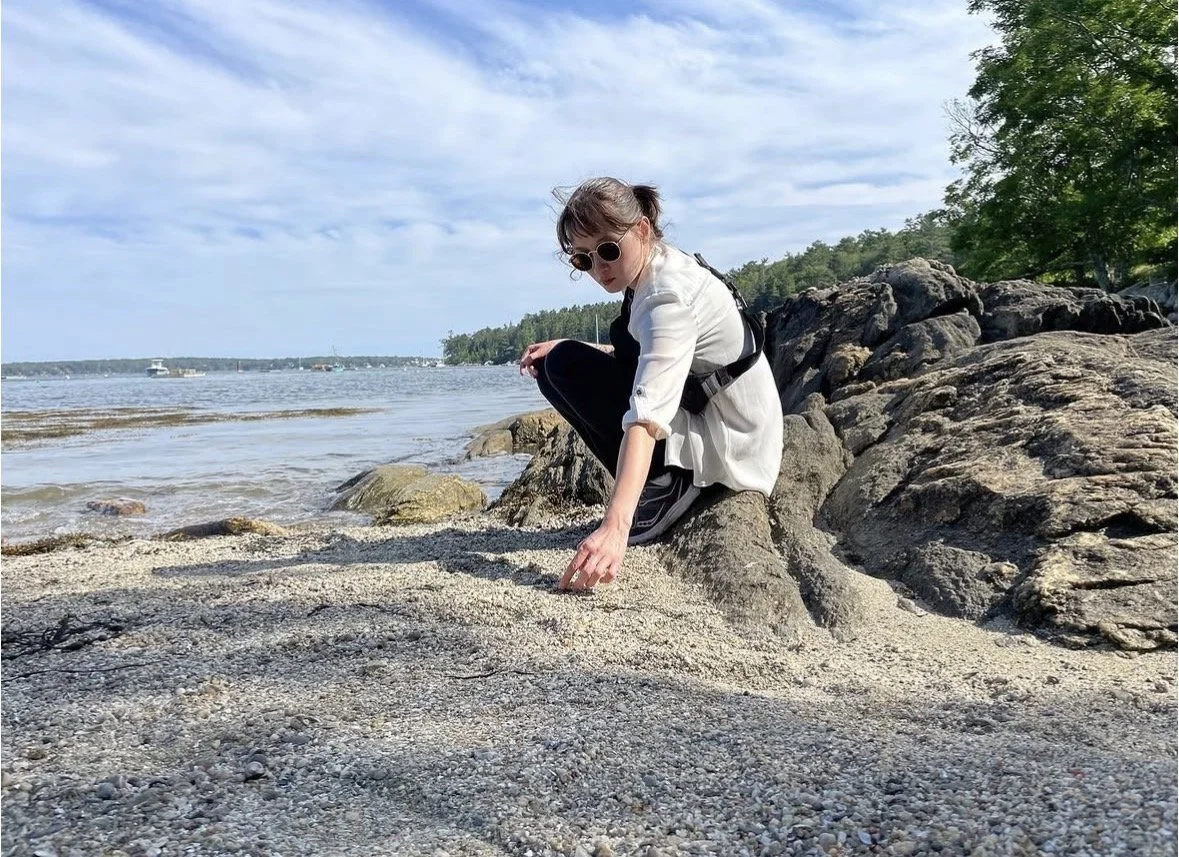
Image of Aiko
Conversation with Aiko Fukuchi, May 2026 (Transcript)
The following conversation was edited down for publication.
Heather Mawson (HM): Hi, Aiko! Thank you for meeting with me. I wanted to start out with a question that Danielle and I were actually discussing when we were on our way to Paper Paper last week. We were talking about the ideal situation for making artwork versus what we have to accomplish while working a full-time job. So I'm curious, with your writing practice, what that looks like for you.
Aiko Fukuchi (AF): Yeah, thank you so much for having me. I've been looking forward to this conversation.
I think it's something I'm constantly trying to figure out and trying to navigate. I do think it's very different for me between prose and poetry. Prose feels like…I need chunks of time. So I'll set aside half a day or something like that, like on the weekend or something, or two solid hours in the evening, that kind of thing. One of the things that compels me to continue writing poetry is that it can be, not necessarily a quicker process, but quicker in terms of… it doesn't necessarily require a huge chunk of time. It can be 10 minutes and then I can be thinking about it all day as I'm doing work, or something like that. So it does feel very different, whereas prose feels like building a puzzle. I feel like I'm creating puzzle pieces, and then figuring out how they fit together, and kind of mapping that out, so the process was quite a bit longer, generally.
HM: So I wanted to bring up your work Undress the Doll, It Is So Lovely, Itsuke, and along with your 2024 chapbook, The First Mirror is a Night Sky; all of them seem autobiographical in nature, and all of your work, from my point-of-view, reckons with some sort of tension. Tension that's felt emotionally and on the body from external or societal cultural pressures. I think about how cultural norms impact and shape personhood in my own work so I know that thinking about this isn't so easy. Sometimes, in my case at least, I tend to overanalyze the work, which can send me into paralysis. What I think is different, and what I love about your work so much, is that you spend time naming and working through complex emotions that arise from these pressures.
Do you approach your work to intentionally work through these tensions, or do you see it as some sort of byproduct of living and writing today?
AF: I've been writing since I was pretty young and I think it definitely came from a place of working through feelings that I didn't necessarily feel like I had a place to express elsewhere. I think it was from a perspective of living in a body that is chronically ill and also with a brain that's neurodivergent. I've been very aware of an interconnectivity between my lived experience, what my body is doing, and how my brain is processing things.
Most of my writing started when I was young, like in third grade and stuff. It was kind of just me trying to make sense of that for myself. I think it's been that for a very long time, and to recall it was me trying to make sense of that for myself, even through college. As I had new experiences that were kind of layering onto the ones that I'd grown up with. I feel like that's evolved as well, where I've also been excited to learn about and think about collective experiences. And how our physical sensations, what we're experiencing in our bodies, and internally more generally is connected to the internal lives of the people that are around us.
HM: Hmm… yeah. I feel like I view that and name that as tension, but I'm curious if you have a different way of thinking about that. There seems to be this grappling with, or working through, what's happening in our bodies. That’s one thing I love about your work, you are able to describe these feelings in ways I never would, but then when I'm reading it, I'm like, oh, wow, that does feel like that. For example, when someone says something really quick or makes a comment, in that moment you can't name all the reasons why that's upsetting, but then you feel it. I really love those moments in your work where you spend time to bring that to the forefront.
AF: Mmm, yeah, that makes me think of something else, which is actually maybe tension, maybe not, I don't know, but I do think that part of the reason I focus on physical sensation and internal experience is because when growing up, I didn't necessarily feel confident that I was smart, basically. So, when you describe knowing something, or feeling something is wrong, or feeling something is off, but not necessarily having the analysis or the articulation of why. I feel like that's something that I resonate with really deeply. I still do, but just haven't always had the confidence to feel like I was able to identify or have an analysis, or that my analysis was important. This was kind of me trying to make sense of that in another way that I felt was more inherent to my… like, I do have these feelings regardless of whether or not I'm smart enough to understand why.
HM: Yeah, totally. In your work you’re building that confidence or allowing yourself to work through that in your writing. I don't know, do you see it as a catharsis? Or maybe catharsis isn't the right word, because it's too emotional, but…
AF: Yeah, it's interesting, I don't know. I have some… feelings about catharsis. But… no, I think that catharsis is limited. I think that at times it definitely has been that. Luckily, gratefully, I’ve been able to get to a place where I feel like I've moved through that a little bit.
At least, in recent years, where I feel like I'm acting more intentionally and trying to connect a bit more of an analysis and clarity around what's happening in the world and how that's being experienced internally, with some more intention that's not necessarily just me expressing or making sense of my personal experiences. It's definitely where everything started for me but I think it's important to move past that. Which was a huge hurdle, and is a huge hurdle. There are many years where my community organizing work felt so divorced from what I was writing. It's been a very intentional shift to try to connect those things.
HM: Yeah, that actually brings me to my next few questions. Another observation I had in your more recent work was a direct or indirect thread to the impact of history on bodies and spaces, especially from your own experience. You even mention the transference of familial trauma in It Is So Lovely. Can you share more about how you view history as an aspect in your work? Especially when thinking about the tension that we just discussed, but also the point about analysis that you're thinking about.
AF: In terms of the body, history feels like it's very present, in a way that we're not necessarily always aware of. I do believe that there are experiences that people in our lineage went through that still resonate within us in some ways. Whether it's like we smell something that's familiar from a moment, and we have a feeling that rushes through us that we can't explain or give context to, because it's not an experience that we had, but it's one that we carry. I think that is very present, for all of us, and I think it's something that I find a lot of power in and a lot of motivation in. It connects us. It connects us to history, and it connects us to each other, and I think we really need to be doing that, in general, when we think about our experiences, but also when we think about trauma as well.
Which, It Is So Lovely, is very focused on a generational history and experience of trauma, and the evolution of that—across generations. One thing I've been thinking about a lot is exceptionalism, or being exceptional, and I think that in the US, that's something that everyone strives for. That's incredibly problematic and harmful. We try to do this with our work, we try to do this with our narratives, we try to do this with our trauma, I think it's connected to…(pause) Catherine Liu is a very complex person, she had this interview that came out recently about monetizing trauma. I really resonate with a lot of what she said in the interview. Basically, when we think about things that way, as we are the exception, we are this individual experience. It really makes it hard for us to work towards any positive or better change. In a way that's actually effective and actually grounded in that goal. I think we're collectively kind of confused about that right now. That's something that I've been trying to do.
It Is So Lovely, is trying to connect my personal trauma with broader histories to express, but also make the connection to myself, and show to myself that what I've experienced, while very tumultuous at times, is not an exceptional experience, unfortunately. It's important to contextualize our experiences that way, so that we can have solidarity, we can build together, we can grow.
HM: Yeah, so we don't feel so alienated from one another and from those of the past, right? I mean, this is somewhat a tangent, but just thinking about how loneliness is so common today, how people feel so disconnected. I know for myself, when learning about history, it makes me feel more connected to not only those that have come before me, but also to the people I'm surrounded by. It reminds me that yes, we have our individual experiences, but those also contribute to a larger momentum and are connected as we move forward.
AF: Absolutely, I totally agree with that. I think we need to be doing that. So much of what I've been reading and thinking about are these personal accounts around how people navigated different points in history where there was increasing fascism, where there were all these things that we're experiencing now. I don't know how we move forward without having that context.
HM: Yeah, for sure. The next question I had ties together your work with… MEGJC… I always want to say GC. M-E-J-C.
AF: All the acronyms with all of the organizations. laughter
HM: Do you think working at MEJC has had an impact on your written work? This question came to my mind when I was reading Under the Fruit Trees. Mariko described her relationship to her garden as a collaboration, the same way a spider or a snake may care for a garden, it reminded me of the work you're doing there. MEJC continues to combat and amend the results of capitalism, inadequate policies, and the negligence of maintaining infrastructure that violently harms our environment, and by interrelation, our own bodies. I imagine from this experience, you are constantly having to think about the ways that extractive and exploitative systems impact our environment. Do you see that coming up in how you think about what you write or maybe does your writing practice impact the work you do at MEJC?
AF: That's a great question. Yeah, I think the environmental justice (EJ) movement, probably more broadly, is the impact. And having been able to be a part of that in various ways and in various roles, has definitely impacted my writing, both in thinking about the connection between our lives and the natural world, and a desire to work towards breaking down that boundary that we've created. I think that that is something that the EJ movement more broadly has definitely impacted my work, and has been something that I've tried to intentionally think about how I can incorporate into my writing. I think it felt unfulfilling to just be thinking about history and context in my experience in writing way over here in one section of my life, and then be thinking about moving things forward organizing and collective betterment in a completely other kind of section of my life… it felt very compartmentalized, separated from each other.
HM: I feel that in my own life.
AF: Okay, yeah, it's really hard to try to bridge them, so I do think that work has definitely impacted thinking about environmental injustice, environmental racism, and what that does to the body. There's such a natural through-line. So much of my work is focused around a chronically ill perspective and neurodivergent perspective. And so much of what pollution does to the body is debilitating and disabling. There's this through-line in thinking about how we internally experience this harm, and also how we witness it and experience it in our external worlds as well.
I was thinking about a lot of the lessons that I learned through EJ around the many different forms of intelligence that exist in the natural world that we're not always prioritizing or making space for or seeing. Also this idea of being a contributor. What does it mean to be a contributor to an ecosystem, rather than a manager or someone who is controlling or guiding a thing as, like, a leader, but just being a contributor and finding value in that.
HM: I think that's beautiful.
This is kind of shifting, but I wanted to bring it up because I've been thinking about how a few weeks back you were talking about migrating your work off of Google Docs, and moving them onto a different platform because of your concerns with AI. I'm wondering how that process is going, and if you care to share more about your thoughts about writing and AI.
AF: Sure, I met with a friend and asked some questions about this new program (Scrivener) that we're both trying out. He's been working with it for a while. It doesn't use AI and isn't connected to it, and I think that it's been going alright. I definitely feel a really deep sense of relief knowing that my work is moving away from these platforms that kind of enforce AI at this point. I know there are settings that you can change and stuff like that, but ultimately, that just doesn't feel secure, also, that's limited and temporary. I think it will become more and more mandated and in a way it already is.
I feel absolutely terrified and also really, really angry. It's very easy to feel angry when you think about AI because it's really destroying our creative lives, and I don't really understand how we can move forward when those muscles are being severely weakened. It also impacts your cognitive ability significantly. It is so, so deeply detrimental to the environment. I really can't imagine any type of justification for using it. I really think it's a devastating pursuit that we need to be collectively vehemently against. Instead, I feel like what I'm hearing in the media and when I talk to people sometimes, it's just like this desire to have nuance around this, but I don't think that we really are in a place to unfortunately… I'm a big fan of nuance in general, but… we're not in a place with AI and with data centers to have much nuance around what is okay and what isn't okay.
We should be looking at where the money's going, who the companies are, and what their history is for who are investing in these technologies, how it's impacting people cognitively, creatively, and our ability to connect with each other. It's also coming after we lived through a pandemic where people are very isolated, and there's a significant uptick in mental health issues just across the board. Then this technology is going to essentially fabricate connection for us. All of that is just completely harmful and detrimental. I'm getting a bit on a rampage, and so I'll stop myself, I don't want to… it's just so deeply appalling to me that we're in the place that we're in globally around the climate, around genocide, around all these different issues that our country is facilitating and this is what we're choosing to prioritize. It's… there isn't a word for it, honestly. It's terrifying, it's appalling, it's infuriating, it's devastating. And I don't want my creative work, which feels like it is my heart and so much of the way that I connect with the people that I love, to have access to that part of me, to be able to incorporate it into whatever AI shit that it wants to do.
HM: Thanks for voicing all that. It's funny, because last night I couldn't sleep at 2am and after an hour of not being able to sleep and trying to cool myself down, I usually read articles, and so I went down this AI in education rabbit hole, where I was reading about the impact of
large language models and AI on the learning process. When thinking about actual learning, like processing information, working through ideas, working through challenging things and being able to overcome them is something that students are not able to do when they're using AI. Let alone, as you mentioned, all of the environmental and labor concerns and creative concerns, in terms of being able to filter information through a body and mind, and then being able to come out with some sort of opinion that is critical. Education is so important to develop critical thinking, and if you're asking ChatGPT to write an essay for you, or to analyze a movie—or in my case, a lot of students are using it to analyze artwork, and then give me a regurgitated opinion. That is just so hard for me as someone who loves art.
AF: Wow.
HM: To think about how students are not challenging themselves to look at something or view something that is challenging and hard to put into words, and for them not to practice that… it makes me really sad, and it does make me very angry when I think about the inevitability that people have with AI, in terms of they're like, oh, it'll let me do more things and I'll be able to expedite all these processes, and it's just like, for what? To write more emails? To do more? That doesn't feel generative or human-centered. This is a total rant. It's easy to get into rants. In our last reflection, Danielle and I talked a lot about AI, so this has been on the top of my mind for many months.
AF: Yeah, I feel like I agree with all the things that you're saying, and the thing that's so upsetting to me…there's so many things. One of the things from what you just said that's so upsetting to me is that when people are not developing and consistently using their critical thinking skills, they're not practicing these skills of analyzing art, identifying, and clarifying their opinion on it, which is very personal. If they're not doing that then people lose their confidence in believing that that's possible, that that's something that they can do.
So then people don't feel like that's something that's accessible to them, even though it is. Then what ends up happening is people are disinvesting from growing these skills more and more, which I think does plateau your cognitive development. It can change, but then if you're not investing in it, then it doesn't.
Then we're creating all of these distractions. There's social media, which is mostly just AI slop anyways right now, and then there's TV. We're being force-fed this in our free time instead of being creative and connecting with the people around them. Also monetizing that time by playing these games and staring at a screen, also Kalshi. So we're developing industries where people are betting on world events, while we're disinvesting in the development of critical thinking. It’s the worst direction we could be moving into right now.
HM: While fascism is on the rise.
AF: Well, it's all interconnected. All that's happening and then the labor element of it we have not really touched on, but many people are not going to have jobs. So this is the world that is being created right now.
I know I brought it up before, about the need to be exceptional, and where that's coming from. It’s coming from the need to monetize our creativity. And the conflation of exceptional with worthiness and having value and being important—I think those things are all very different, and we're getting them very, very muddled. All the things we're talking about with AI, and all these other platforms that we're referencing is only making that more muddled and creating a greater loss of our ability to clarify and distinguish between those terms. Which is deeply concerning.
HM: I think that's time. Are there any last projects or things you wanted to bring up?
AF: No, can I say one more thing about AI?
HM: Of course.
AF: Cut this or not, but I just think AI writing doesn't say anything. It sounds professional and clear, and all these things when you read it, it sounds like it was written by corporate speak. It sounds like it was written by a corporate professional, but when you try to actually think about what it's saying, it really doesn't accomplish anything. It doesn't communicate anything. It is wild to me that so many of us are turning to a platform that can perform comprehension, but it can't communicate effectively.
HM: Yeah, I totally agree, and that is why writers, such as yourself, are so important. AI could never write the way you write. It's coming from a place that is so felt, and just the way that you are able to articulate experiences is very exciting… I don't get that when I read AI. I read a lot of AI slop now because over this past semester the majority of students are using it now. And it's all assignments that are supposed to give their opinion about art so that is why it is even more concerning and it makes me very angry. I go home like this a lot (throws fists into air), and I'm just like, what are they doing?
AF: Me too! I mean, during this conversation, there was a point when I was like, oh no, I hope Heather doesn't feel like I'm yelling at her. But I was just getting fired up about… it's just… it's just so… I'm so angry.
End.