Reflection 01: October - December 2025
The central question to our work, “what is art’s role in making a better world possible?,” is not intended to be overly ambitious; we don’t seek the “right” answer to this question. Rather, we anticipate a multitude of answers from a variety of perspectives, which leads us to practice our engagement in a united struggle with a more concerted, personally beneficial, and mutually impactful approach.
When we announced the revitalization of Nox Library in October, it was with this question in mind that we embarked on a new path toward an art-centered political education. Much like our efforts from 2019-2023, we maintain an interest in providing free literature to help build this education. We tabled at the Detroit Art Book Fair for the first time since 2022 with free printed copies of our conversations, book reviews, and reading guides. As we continue to grow, there is more we want to produce and give away. With this, we are faced with a challenging question: how can we maintain our not-for-profit approach while raising enough funds to publish, print, and distribute our work for free? While we look forward to hosting events and tabling at public fairs in 2026, we continue to consider alternative models to sustain our free literature distribution efforts [1].
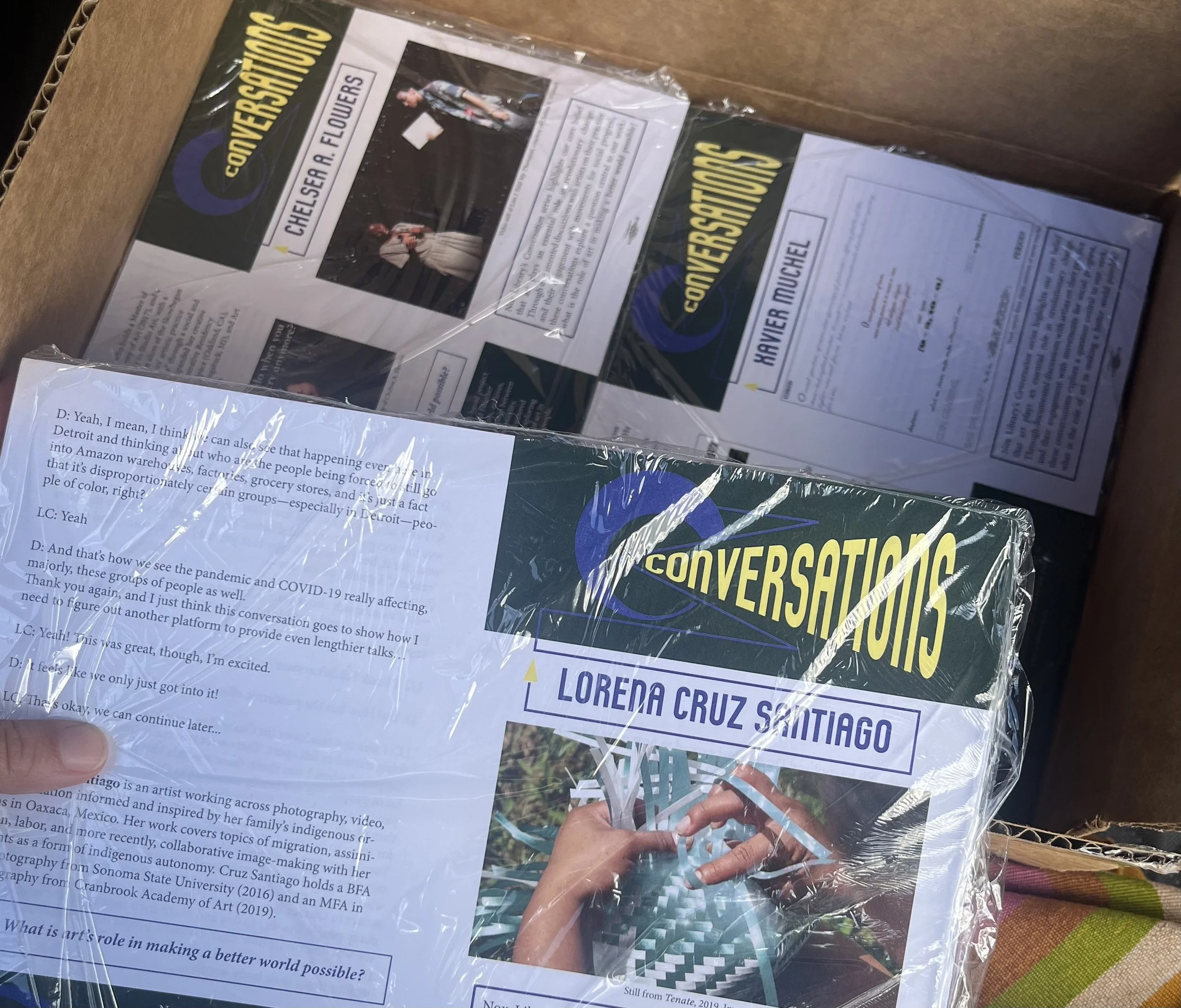
Also in October, we began to reconnect with Nox Library’s roots; we published a Conversation with xavier muchel, an artist and friend who contributed to Nox Library in its early stages. Our conversation reflects on his personal and creative developments, as well as what it meant to him to be involved with a project like Nox. When Nox initially started, it sought to establish an alternative source of engagement with art and politics outside of academia and billionaire-funded institutions. We wanted to forge our own grassroots movement to empower ourselves and others through collective knowledge building—this is the legacy upon which Nox Library stands today.
Art presents us with a perspective for learning the history of people’s movements and the historical struggle between classes. Whether intentional or not, art, design, architecture, and music are all shaped by the political and socio-economic contexts of their time. This mirrors our conditions for living and working—conditions which, in turn, shape art. In our conversation with xavier, he mentioned how his art practice changed once he moved to New York and had to operate in a smaller space. New York City is one of the most expensive places in the world to live, and xavier’s story is a direct example of how increased cost of living, gentrification, and policy shape conditions within a city and thus an artist’s practice.
The realization of art’s contribution to societal change is limited by the existence of a siloed “art world,” a terrain composed of billionaire sponsorships, social climbing, a de-radicalization of art, and a centering of individualism. Artists and cultural workers alike feel required to navigate this ecosystem not only to maintain their connection to the arts but to also survive as cultural bearers in this world. While community is a pillar for growth and sustainability in the arts, that connection to community is frequently misappropriated as networking. In the art world, networking has developed into a maneuvering of relationships with an applied pressure to sell, make money, build a personal brand, and potentially achieve notoriety. This is not the consequence of greed or narcissism from artist communities—artists are merely working within the system that exists in order to pay their bills and sustain life under capitalism. Rather, it is a decades-long neoliberal takeover of the art sector that has compelled it to march along with big business. When it comes to being driven by the bottom line, the art world is not exempt.
While we seek to build an art-centered political education, we turn to artists for their perspectives on how art helps make a better world possible. In November we published a Conversation with bree gant, where they discussed how their lived experiences function as a form of political education—particularly riding the Detroit bus lines.
Detroit is known as the Motor City because of its grip on the auto-industry since the early 20th century. While prevailing narratives depict Detroit as a proud bastion of automotive innovation in America, its history tells a different story. When bree mentioned that riding the bus is political education, we inadvertently reflected on the radical act of utilizing public transportation in the Motor City. Public transit is a public service, which—if properly invested in—would have benefitted all working people in Detroit. Instead, it has been neglected and circumvented by the local government in an effort to construct a city dominated by cars and freeways. Using public transportation should not be radical, and policies that put profit over people for decades—thus causing a deteriorating public transit system, as well as widespread gentrification and displacement—should not be normalized. But here in Detroit, it is.
The following is an excerpt from a poem called Motor City by Breanna Krywko that emphasizes this point further,
…
They demolished our neighborhoods so they could put up highways.
They put up highways so the downtown businesses could maintain access to those who became suburbanites. They welcomed suburbanites downtown because they would spend their disposable wealth and avoid the inner city. They wanted the well-off to avoid the soul of Detroit so they would believe any lie told by the media.
Detroit was dangerous and full of criminals, so the city could be left to rot.
They demolished our neighborhoods so they could put up highways.
They criss-crossed our town with highways and dubbed us the motor city; Motown.
We would build the vehicle of our own destruction and be called by its name.
Mocking us, because they would take everything within their reach while they postured as our hope for salvation.
Because we dared to resist our chains, because we refused to be left to rot,
They demolished our neighborhoods so they could put up highways.
…
The erasure of Detroit’s Black Bottom neighborhood serves as one of the most notable examples of destruction and displacement in American history. Situated just east of Downtown and south of Gratiot, it was home primarily to Black residents and Black businesses, isolated due to red-lining and racial segregation. There also lived a small population of Jewish residents who were similarly subjected to racist real estate practices. Black Bottom, alongside Paradise Valley—another predominantly Black neighborhood with bustling Black-owned businesses—was razed in the 1960s for the construction of I-375 [2]. This scenario exemplifies how the nickname, Motor City, attempts to subdue the complicated and violent history automotive culture has in Detroit.
Krywko’s poem was one of many works presented from November 13 - December 20, 2026 at Swords into Plowshares exhibition: Detroit 2050: A Future Beyond Billionaires. The show exposed the control that billionaires have on Detroit and the city’s arts and culture. Through collaboration with city and state politicians, billionaires such as Dan Gilbert, Tom Gores, and the Moroun family—in conjunction with large development firms—are granted public, tax-generated funds through state and city-sanctioned policies—such as tax captures and abatements—to advance their interests while de-prioritizing the needs of working class Detroiters. One of the groups that participated in the show, Detroiters for Tax Justice, has spent years researching and calling out Mayor Mike Duggan’s administration for enabling the theft of tax dollars by billionaire developers. Through tax abatements and tax captures, our public libraries lost $53.9 million between 2014-2023, diverted to projects such as the Detroit Pistons multi-million dollar collaboration with Henry Ford to develop the New Center area of Detroit. Meanwhile, library facilities in Detroit are closing down. This is the central concern over which Detroiters for Tax Justice was formed.[3] Those who benefit from the disablement of public amenities by the capture of tax dollars for development projects that accelerate the gentrification of Detroit, are the same billionaires who fund arts and culture in the city.
Detroit 2050: A Future Beyond Billionaires is the second anti-oligarch show at Swords into Plowshares. The first, Community Power: Artists Demand More from DTE, focused on the violent consequences of DTE prioritizing shareholder concerns over the people that depend on their services for bare minimum quality of life. Detroit 2050, similarly to the DTE show, brought together community activists and organizations to create an exhibition that addressed the current impacts of billionaires in the city. It also imagined a future where billionaires do not dictate the cultural vision of the city. “Fund Libraries, Not Library Street” was a call made by show organizers on flyers and t-shirts, specifically referring to Library Street Collective, an art-gallery chain owned by real-estate developer Anthony Curis, and is in partnership with the billionaire Gilbert family.
This exhibition, and the questions it raises, couldn't have come at a better time as the new Lumana creative art center, a project initiated by Jennifer Gilbert, was recently announced. This initiative is one part of a larger development project taking shape on Detroit’s water-front, dubbed Stanton Yards. It is an extension of “Little Village,” another in-development neighborhood in east Detroit spearheaded by Library Street Collective. Detroiters can look no further to witness how arts and culture are the instruments of profit and seizure in the takeover of neglected and under-served neighborhoods. Little Village is self described as “a cultural corridor fostering an inclusive community centered around the arts,” and Stanton Yards is described to be “a 13-acre cultural amenity for the community, with over 80,000 square feet of commercial and creative space, 85 boat slips, and programmed waterfront parks.” It remains unclear how these commercial and creative spaces, as well as 85 boat slips, will serve Detroiters, or how the ongoing private development of the area will curb gentrification and displacement.
The Detroit river front has seen a resurgence of development in the past few years, nevermind the $44 million scandal left in the shadow of the Riverfront Conservancy. Tom Gores and the Detroit Pistons franchise recently won the support of Detroit City Council to take over the old Uniroyal site for a new WNBA headquarters. The major win comes with a Brownfield tax capture development incentive all while by-passing a community benefits ordinance [4]. The City sold the land to the Brownfield Authority of the Detroit Economic Growth Corporation which will in turn lease it to Gores and his accomplices for free. This is a common scenario which groups like Detroiters for Tax Justice have been fighting against for years. The other major sports complex in Detroit, Little Caesar’s Arena, enjoys similar benefits: the Downtown Development Authority owns the land and leases it to the Ilitches for zero dollars, with tax incentives. Krywko’s poem returns to the forefront of our minds as we consider whom these developments, perfectly situated off the freeway downtown, serve in the end: They welcomed suburbanites downtown because they would spend their disposable wealth and avoid the inner city.
Meanwhile, ICE continues to terrorize communities and abduct workers and youth across the city. Only weeks ago, four students at Western International High School were abducted and detained by federal immigration authorities. The grassroots organization at the frontlines of resisting ICE and defending the communities most vulnerable to immigration enforcement is Assemblea Popular. Our federal tax dollars fund US-led terrorism abroad and at home, while Detroiters see our city tax dollars captured and re-directed from libraries and public schools to multi-million dollar development projects [5]. It’s unclear in its early stages whether Stanton Yards will pursue any tax incentives [6].
At Nox we pose the question: how do artists respond to these challenges?
A look at history tells us that artists have always stepped up to the task when survival depends on a resistance to capitalism and imperialism. A few artists that exemplify this are Käthe Kollwitz, Billie Holiday, and Paul Robeson. There are also many contemporary examples we can point to. In our conversation with Juan Carlos Rodríguez Rivera, he discusses a collaborative art project, Images for Decolonial Futures, that facilitates workshops to bring community members together and give them a platform for imagining a de-colonial future in Puerto Rico.
But what can be said of the art world? Since it exists as an extension of capitalist exploitation of culture and a bulwark of bourgeois ideology, it not only fails to effectively resist capitalism and imperialism, but it is actively complicit in their rise [7]. Artists, therefore, may find their role in revolutionary change to exist outside of the art world, in defiance of it. Art, after all, is political, and artists exist first and foremost as people beyond the world of art [8].
An art-centered political education requires a community centered around the lived experiences of artists. In Study Group we will dive further into the relationship between art and revolutionary change by exploring themes around art, community, capitalism, peace, imperialism, and more. Study group is our alternative to traditional academic or institution-based learning. As a space that prioritizes collectivity, it is for artists and cultural workers to come together, support one another, and think critically about how we struggle through our conditions today. This practice is integral to the survival of art and it is essential to imagining the power of art beyond capitalism. A better world is possible, and it is unity and collective knowledge building that bring us one-step closer.
Heather and Danielle, Oct-Dec 2025 [9]
[1] Currently, we personally front the cost of all printed material. The donations and purchase of anything from Nox goes to paying us back for the printed goods. Any additional leftover money goes back to Nox Library for administrative costs (i.e. website) and for future free materials. We do not make any money from Nox Library.
[2] Origins of an Urban Crisis by Thomas J. Sugrue is one book we recommend to learn more about the destruction of Black Bottom and similar gentrification projects in Detroit. We also encourage you to check out the Black Bottom Archives.
[3] More information about the Detroit 2050: A Future Beyond Billionaires exhibition at Swords into Plowshares and information that Detroiters for Tax Justice put together in their Billion Dollar Report can be found in an essay we wrote for Runner Magazine, Detroit 2050: A Present With and a Future Beyond Billionaires published on December 13, 2025.
[4] In the City of Detroit, as voted on by Detroiters in 2016 and later amended by city council in 2021, the Community Benefits Ordinacne requires developers to engage with neighboring communities through the establishment of a Neighborhood Advisory Council with the goal to agree on benefits for the community as well as address foreseen negative impacts of the development in the community. This would apply to projects that meet Tier 1 criteria: the project is $75 million or more in value and receives $1 million or more in property tax abatements. While the WNBA project is receiving more than $1 million in tax abatements, the project is projected to be $50 million in value, therefore it is classified as Tier 2 and is not obligated to a Community Benefits Ordinance.
[5] The institute of Policy Studies puts out a report each year that highlights how the average tax payer’s dollars are being spent. In 2024, the average US taxpayer paid $98 to border patrol, deportations, and immigration detentions.
Also in 2024, the average US taxpayer paid $3,707 towards weapons and war. This includes $2,929 to the Pentagon, and the remaining to nuclear weapons and foreign militaries. This, however, was under the previous administration. We anticipate the number to have increased since Trump took office.
[6] We've reached out to our friends in Detroiters for Tax Justice to hear what they've learned on this. Update 01/30/2026: It turns out the Stanton Yards project already received certificate of tax exemptions in 2024. The developer, registered as Little Village Marina, LLC, has been granted just over $2.4 Million in tax abatements.
[7] To re-iterate, the art world is not a world in and of itself; the art world is how we refer to the social structure that exists to silo and control art, art education, art scholarship/research, and the art market, as well as exploit artists and cultural workers to sustain bourgeois ideology and uphold capitalism/imperialism. Art and the work of artists can exist outside of the art world and as part of the world.
[8] Swords into Plowshares and the recent union drive at the Detroit Institute of Arts are two more examples of this. SIP collaborates with community members and organizers as frequently as it does with artists, and DIA Workers United is a collective resistance to the institutional exploitation of workers which the art world has historically perpetuated.
[9] Many thanks to our dear friend Joey for his peer review of our writing and analysis.